
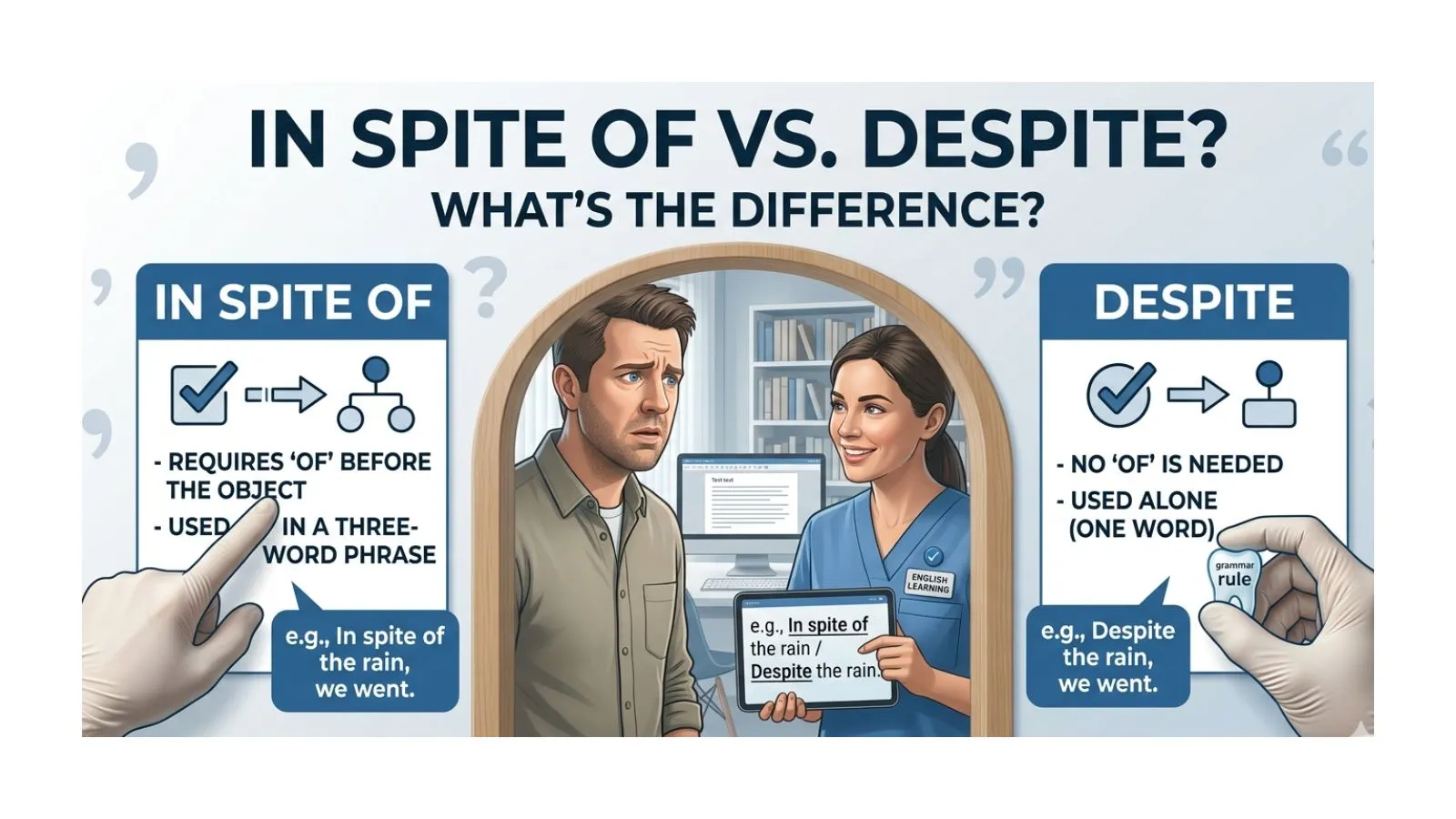
Many people search for “in spite vs despite” because the two phrases look different but seem to mean the same thing. That can feel confusing, especially when writing emails, essays, or social posts. You might wonder: Which one is correct? Can I use both? Is one more formal?
The truth is simple: both “in spite of” and “despite” have the same meaning, but they are used slightly differently in sentences. This small difference causes many common mistakes.
|See more Caramel or Carmel
This guide solves that confusion. You will learn the quick answer, see clear examples, and understand when to use each phrase. We will also look at common mistakes, real-life examples, and usage trends. By the end, you will feel confident using both forms in everyday writing.
In Spite vs Despite – Quick Answer
Both “in spite of” and “despite” mean the same thing:
👉 Something happens even though there is a problem or obstacle.
Examples:
- Despite the rain, we went outside.
- In spite of the rain, we went outside.
✔ Both sentences are correct and mean the same.
Key Difference:
- Despite = shorter
- In spite of = slightly longer
👉 You must use “of” after “in spite”
❌ In spite the rain → wrong
✔ In spite of the rain → correct
The Origin of In Spite vs Despite
Both phrases come from old English and Latin roots.
- Despite comes from Latin despectus, meaning “to look down on” or “ignore.”
- In spite of comes from the word spite, meaning “defiance” or “resistance.”
Over time, both phrases began to mean the same thing:
👉 Ignoring a difficulty or obstacle.
That is why today they are interchangeable in meaning, even though they look different.
British English vs American English Spelling
Good news: there is no spelling difference between British and American English for these phrases.
Both forms are used in:
- 🇬🇧 British English
- 🇺🇸 American English
Comparison Table
| Phrase | British English | American English | Notes |
|---|---|---|---|
| Despite | ✔ Common | ✔ Common | More concise |
| In spite of | ✔ Common | ✔ Common | Slightly formal |
👉 The difference is not about spelling. It is about style and length.
Which Spelling Should You Use?
Choosing between in spite of and despite depends on your audience and writing style.
Use “Despite” when:
- You want short, clear writing
- Writing emails or social media
- Writing for global audiences
Use “In Spite of” when:
- You want a slightly formal tone
- Writing essays or reports
- You need emphasis
Quick Advice:
- For most cases → Use “despite”
- For formal writing → Either is fine
Common Mistakes with In Spite vs Despite
Here are common errors and how to fix them:
Wrong: In spite the rain
✔ In spite of the rain
❌ Despite of the rain
✔ Despite the rain
❌ Mixing both forms:
❌ Despite of → wrong
✔ Despite → correct
Tip:
- “Despite” → no “of”
- “In spite” → always “of”
In Spite vs Despite in Everyday Examples
Emails:
- Despite the delay, we completed the work.
- In spite of the delay, we completed the work.
News:
- Despite heavy traffic, the event started on time.
Social Media:
- Despite being tired, I went to the gym 💪
Formal Writing:
- In spite of challenges, the project succeeded.
👉 Both work in all contexts. “Despite” is just more common.
In Spite vs Despite – Google Trends & Usage Data
Search data shows that “despite” is used more often than “in spite of.”
Trends:
- Despite → more popular worldwide
- In spite of → used in formal writing
By Region:
- 🇺🇸 USA → prefers “despite”
- 🇬🇧 UK → uses both equally
- 🌍 Global → “despite” is dominant
👉 Reason: people prefer shorter words in modern writing.
Comparison Table: In Spite vs Despite
| Feature | Despite | In Spite of |
|---|---|---|
| Meaning | Same | Same |
| Length | Short | Longer |
| Formality | Neutral | Slightly formal |
| Usage | More common | Less common |
| Needs “of”? | ❌ No | ✔ Yes |
FAQs:
1. What is the difference between despite and in spite of?
No real difference—both mean “even though.” Just remember: despite doesn’t need “of,” but in spite does.
2. Is there any difference between inspite and despite?
Yes—“inspite” is incorrect. The correct form is “in spite of”, while “despite” is a single word.
3. How to use despite and inspite with examples?
Use despite + noun: “Despite the rain, we went out.”
Use in spite of + noun: “In spite of the rain, we went out.”
4. What’s the origin of the phrase “in spite of”?
It comes from “spite,” meaning defiance—so it originally meant doing something in defiance of difficulty.
5. What can I say instead of “in spite of”?
You can use despite, although, even though, or regardless of.
6. Is it despite me or in spite of me?
Both are correct, but “despite me” is more common; “in spite of me” is slightly more formal.
Conclusion
Understanding “in spite vs despite” is easier than it seems. Both phrases mean the same thing: something happens even when there is a problem. The main difference is structure. “Despite” is shorter and does not need “of,” while “in spite” always needs “of.”
In modern writing, “despite” is more popular because it is simple and quick. However, “in spite of” still works well, especially in formal writing or when you want to add emphasis. There is no difference between British and American English, so you can use either anywhere in the world.
The key takeaway is to avoid common mistakes. Never write “despite of,” and always include “of” after “in spite.” Once you remember this rule, you will use both phrases with confidence.
Choose based on your style: short and simple, or slightly formal. Either way, your meaning stays clear.