
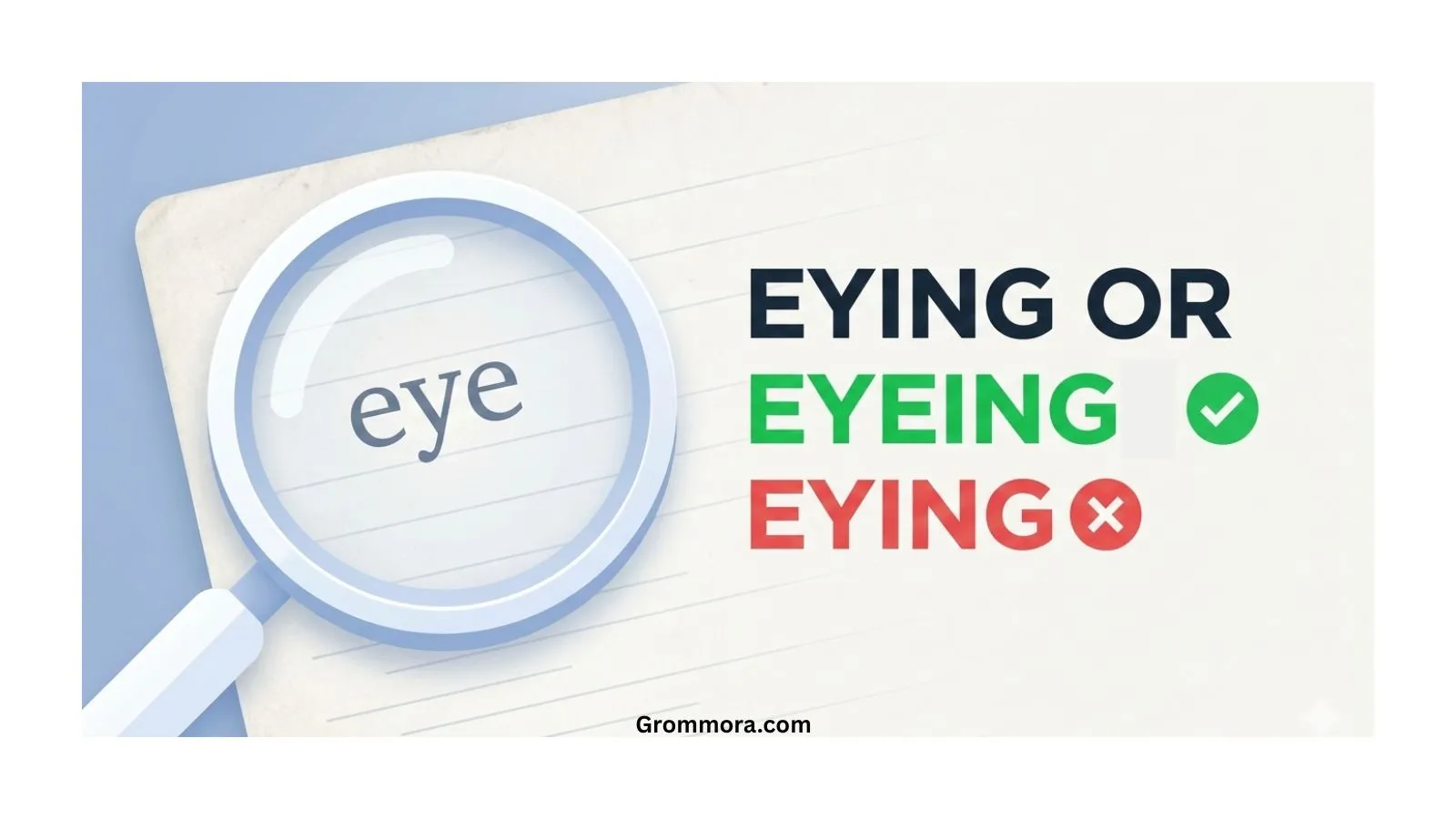
Have you ever paused while writing and wondered: Is it “eying” or “eyeing”? You’re not alone. Many writers, students, and professionals search for this exact keyword because the spelling looks strange either way. The word comes from “eye,” so adding “-ing” can feel confusing. Should you keep both “e” letters? Or drop one?
This confusion often shows up in emails, essays, news articles, and social media posts. Since spelling matters in professional writing, people want a clear and simple answer. They also want to know if the spelling changes between American and British English.
In this article, you’ll get a quick answer first. Then we’ll explain the origin, spelling rules, common mistakes, usage examples, and even Google Trends insights. By the end, you’ll know exactly when to use eying or eyeing — and why.
Eying or Eyeing – Quick Answer
The correct and most common spelling is “eyeing.”
“Eyeing” means looking at something with interest or desire.
Examples:
- She is eyeing the last slice of cake.
- The company is eyeing a new market.
- He was eyeing the job offer carefully.
The spelling “eying” exists, but it is rare and less common. Most dictionaries and style guides prefer eyeing.
The Origin of Eying or Eyeing
The word comes from the noun “eye.” When we turn “eye” into a verb, it means “to look at closely.”
In English grammar, when adding -ing to words ending in “e,” we usually drop the final “e.”
Example:
- Make → making
- Write → writing
But “eye” is different because it ends with two vowels (“e” + “y” + “e”). Dropping one “e” would make it harder to read. So English keeps both “e” letters in eyeing.
That is why eyeing became the standard spelling over time.
British English vs American English Spelling
Unlike words such as “color/colour” or “organize/organise,” this spelling does not strongly differ between British and American English.
Both regions mostly use eyeing.
Comparison Table
| Version | American English | British English | Preferred? |
|---|---|---|---|
| eyeing | ✅ Common | ✅ Common | Yes |
| eying | ⚠️ Rare | ⚠️ Rare | Not preferred |
Both spelling systems accept “eyeing,” and it is widely used in media worldwide.
Which Spelling Should You Use?
Here is simple advice:
- Writing for US audience? → Use eyeing
- Writing for UK/Commonwealth audience? → Use eyeing
- Writing for global audience or SEO? → Use eyeing
If you want safe, professional writing, always choose eyeing.
The spelling eying may appear in older texts, but it is not common today.
Common Mistakes with Eying or Eyeing
Here are frequent errors:
Wrong: She is eying at the car.
✅ She is eyeing the car.
❌ The company is eyeing to expand.
✅ The company is eyeing expansion.
❌ He was eyeing on me.
✅ He was eyeing me.
Remember:
- Do not add “at” or “on.”
- Use it directly before the object.
Eying or Eyeing in Everyday Examples
Here is how it appears in daily writing:
Emails
- “We are eyeing new partnership opportunities.”
News Headlines
- “Tech giant eyeing AI investments.”
Social Media
- “I’m eyeing that new phone 👀”
Formal Writing
- “The board is eyeing strategic growth options.”
It works in both casual and formal settings.
Eying or Eyeing – Google Trends & Usage Data
Search data shows that “eyeing” is far more popular than “eying.”
- United States → Eyeing is dominant
- United Kingdom → Eyeing is dominant
- Canada & Australia → Eyeing is also preferred
The rare spelling “eying” gets very low search volume. Most global publications use eyeing.
Keyword Comparison Table
| Keyword Variation | Popularity | Recommended |
|---|---|---|
| eyeing | High | ✅ Yes |
| eying | Very Low | ❌ No |
For SEO, always focus on eyeing.
FAQs
1. Is it eying up or eyeing up?
It is eyeing up. “Eying up” means looking at something with interest or desire.
2. Is it spelled eyeing or eying?
The correct and common spelling is eyeing. “Eying” is rare.
3. What does eyeing it mean?
“Eyeing it” means looking at something carefully or with interest.
4. What does “eying someone” mean?
It means looking at someone closely, often with curiosity or attraction.
5. How do you use eying in a sentence?
She is eyeing the new laptop in the store.
6. Why do people say “ey up”?
“Ey up” is a casual greeting meaning “hello,” mainly used in Northern England.
7. How do you spell side eying?
The correct spelling is side-eyeing (or side eyeing). It means giving a suspicious look.
8. Who says “ey up”?
People in Northern England, especially in Yorkshire and nearby areas, say “ey up.”
Conclusion
So, what’s the final answer to eying or eyeing?
The clear winner is eyeing. It is the standard spelling in both American and British English. It appears in news articles, business writing, and online content. While “eying” exists, it is rare and not recommended for professional use.
The confusion happens because English spelling rules can feel inconsistent. Most verbs drop the final “e” before adding “-ing.” But “eye” is special. Keeping both “e” letters improves readability and clarity.
If you want correct spelling, better SEO, and professional writing, always use eyeing. Now you can write with confidence and avoid this common mistake.