
English grammar can be tricky, especially While it comes to when to use whom or who. Many people struggle with this distinction, often second-guessing themselves in emails, essays, or even casual messages. The confusion arises because both words refer to people, yet they serve different grammatical functions. Misusing “who” and “whom” can make writing seem less professional, and for students, it can even affect grades.
Understanding when to use whom or who solves this problem. This guide will give you clear, practical rules, examples, and common mistakes to avoid. We’ll explore the origins of these words, differences between British and American usage, and provide advice on which version to use in different contexts. By the end of this article, you’ll feel confident using “who” and “whom” correctly in everyday writing, formal documents, and online communication.
When to Use Whom or Who – Quick Answer
Quick Answer:
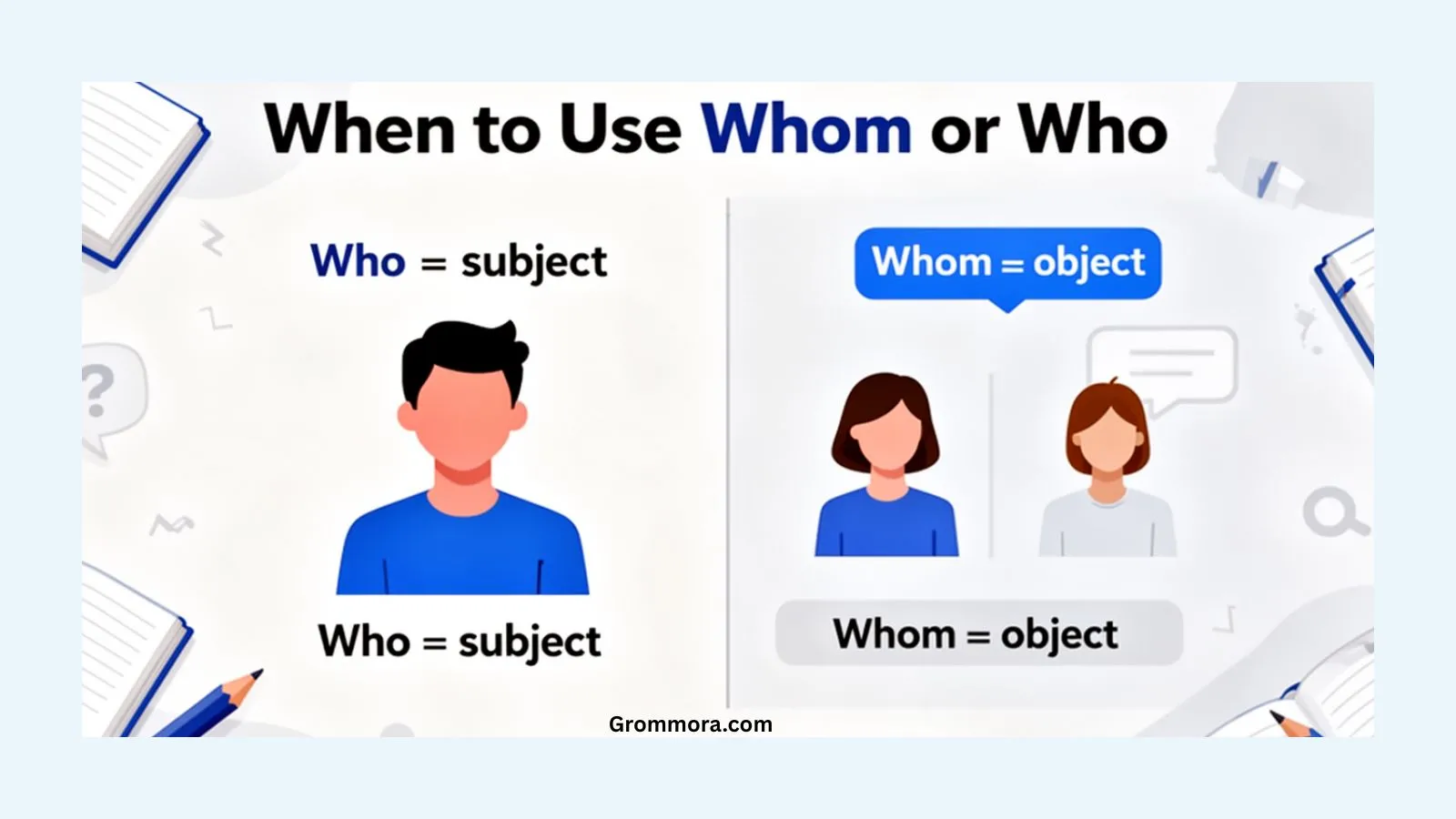
- Who = subject of a sentence (the person doing the action)
- Whom = object of a sentence (the person receiving the action)
Examples:
- Who called you yesterday? → “Who” is the subject doing the action.
- To whom should I send this email? → “Whom” is the object receiving the action.
- She knows who is coming to the party.
- I met a person whom everyone admires.
Tip:
If you can replace the word with “he/she,” use who. If “him/her” works, use whom.
The Origin of When to Use Whom or Who
Both who and whom have roots in Old English:
- Who comes from hwā, meaning “which person.”
- Whom comes from hwām, meaning “to whom” or “for whom.”
Over centuries, English grammar evolved, keeping who for subjects and whom for objects. The distinction has faded in spoken English, making whom seem formal or old-fashioned. However, written English, especially academic or professional writing, still favors correct usage.
British English vs American English Spelling
The distinction between who and whom is consistent in spelling across British and American English, but usage differs:
| Feature | British English | American English |
|---|---|---|
| Formality | Whom often used in formal writing | Whom less common; “who” used more |
| Everyday conversation | Rarely used, considered formal | Rarely used, almost archaic |
| Written English | Maintains traditional grammar | Often relaxed, “who” replaces “whom” |
| Legal/academic writing | Whom preferred for correctness | Whom still accepted but optional |
Example:
- British: To whom should I address this letter?
- American: Who should I address this letter to?
Which Spelling Should You Use?
Your choice depends on audience and context:
- US audiences → Using “who” is acceptable in most contexts; “whom” is optional.
- UK/Commonwealth audiences → Use “whom” in formal or professional writing.
- Global readers → When in doubt, follow the quick subject/object rule: who = subject, whom = object.
Tip: In casual writing like emails or social media, “who” is safe. In formal writing, using “whom” correctly adds professionalism.
Common Mistakes with When to Use Whom or Who
Many writers make these mistakes:
- Using who as an object: Who did you meet yesterday? → Correct: Whom did you meet yesterday?
- Using whom as a subject: Whom is calling? → Correct: Who is calling?
- Ending formal sentences incorrectly: Who should I give this to? → Better: To whom should I give this?
- Overusing “whom” in casual contexts, making sentences sound stiff.
When to Use Whom or Who in Everyday Examples
- Emails: To whom it may concern (formal)
- News articles: The actor, who won an award, thanked fans.
- Social media: Who else is excited for the game tonight?
- Academic writing: Students for whom this applies must register by Friday.
Quick Tip: The subject/object trick works everywhere: check if the word is doing or receiving the action.
When to Use Whom or Who – Google Trends & Usage Data
According to Google Trends, searches for “when to use whom or who” peak during school terms and exams, indicating students often seek clarity. Usage is highest in English-speaking countries, with significant interest in the US, UK, Canada, and Australia. Social media and professional platforms show “who” overwhelmingly dominates casual usage, while “whom” appears mostly in formal contexts.
Keyword Variations Comparison Table
| Variation | Usage Frequency | Context |
|---|---|---|
| Who | High | Casual & formal |
| Whom | Medium | Formal & academic |
| Who vs Whom | High | Queries & guides |
| When to Use Whom or Who | High | Educational/SEO intent |
| Whom vs Who | Medium | Grammar explanations |
FAQs
1.Who vs whom examples sentences?
“Who” is the subject (Who ate my pizza?), and “whom” is the object (Whom did you call?).
2.Which sentence correctly uses who or whom?
“She is the woman who helped me” (subject) and “He is the man whom I admire” (object) are correct.
3.What are the common mistakes when using who/whom?
Using “whom” as a subject (e.g., “Whom is coming?”) or avoiding it entirely when grammar requires it.
4.Is it correct to say whom am I talking to?
Yes, but it’s formal; most people say “Who am I talking to?” in casual conversation.
5.What is the trick for who and whom?
Replace “who” with “he” (subject) and “whom” with “him” (object)—if “him” fits, use “whom.”
6.Is using ‘whom’ pretentious?
It can sound overly formal in casual speech, but it’s correct in formal writing.
7.Why do people say whom instead of who?
To sound more grammatically precise or formal, though it’s often used incorrectly.
8.Who vs whom act examples?
On the ACT, “who” is used for subjects (The teacher who taught me) and “whom” for objects (The teacher whom I admired).
Conclusion
Mastering when to use whom or who improves both clarity and professionalism in writing. Remember: who for subjects, whom for objects. While spoken English favors “who,” formal writing still values proper use of “whom.” By understanding the origin, common mistakes, and context differences between British and American English, you can confidently write emails, essays, and social media posts without grammatical hesitation. Always consider your audience—casual or formal—and apply the subject/object rule for quick, accurate results. With practice, knowing While to use whom or who becomes second nature, ensuring your writing remains clear, polished, and grammatically correct.