Many English learners and writers often ask about “using like or as.” These two small words seem simple, but they cause a lot of confusion. People search for this keyword because they want to know which word is correct in a sentence and when to use each one.
|See also Finaly or Finally
Both words compare things, but they work in different ways in grammar. In everyday speech, people sometimes use them the same way. However, in formal writing and professional communication, the difference matters.
For example, many people say:
- “Do it like I told you.”
But formal grammar suggests:
- “Do it as I told you.”
This article explains how to use like and as correctly, why they are confusing, and how usage differs across contexts. You will learn quick rules, examples, common mistakes, and real-life usage in emails, social media, and formal writing. By the end, you will clearly understand when to use like and when to use as.
Using Like or As – Quick Answer
Quick rule:
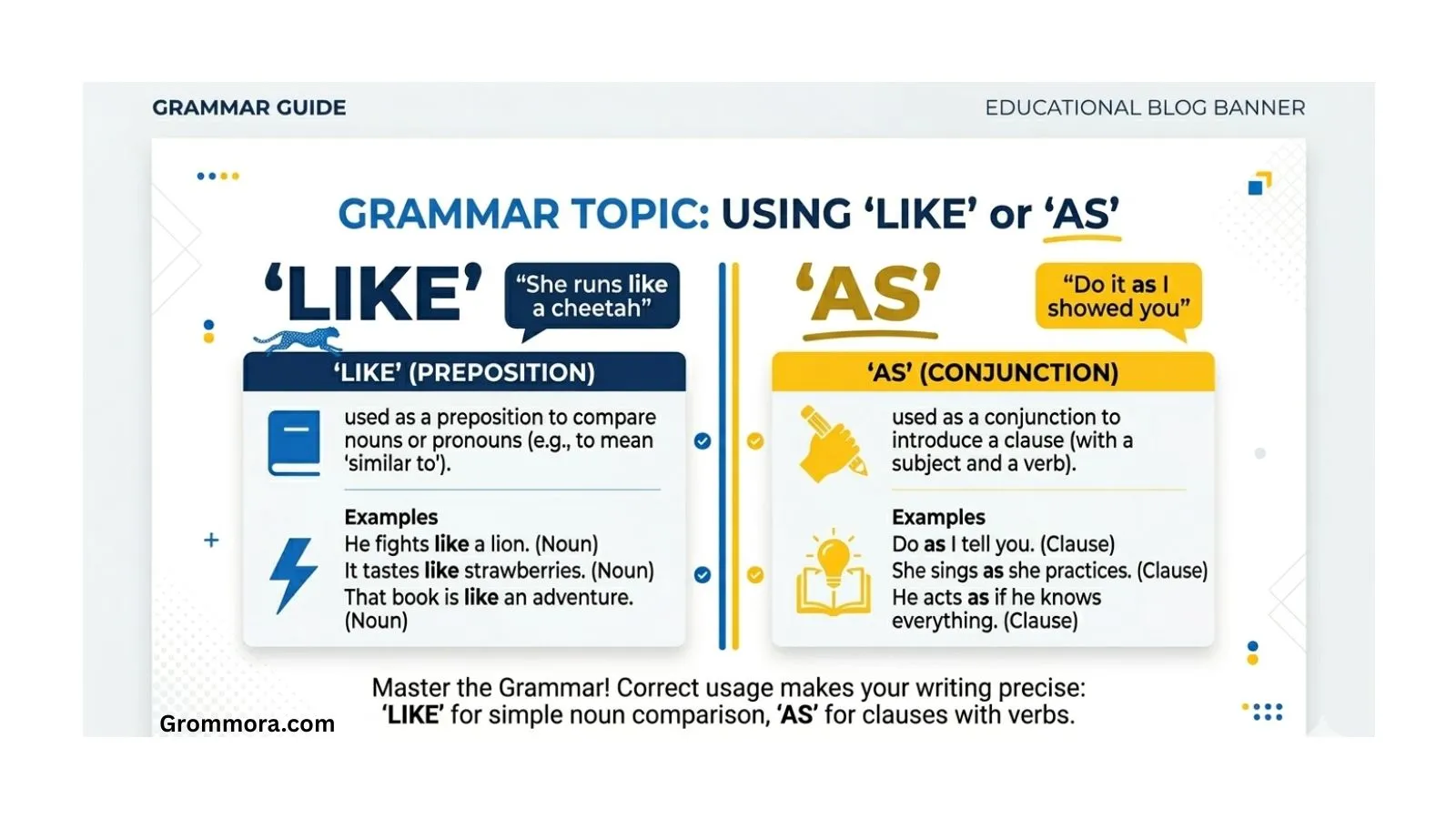
- Like is used to compare nouns or pronouns.
- As is used before a clause (subject + verb).
Examples
✔ Correct:
- She sings like a professional singer.
- Do it as I explained.
❌ Incorrect:
- Do it like I explained.
- She sings as a professional singer. (Wrong in many contexts)
Simple Rule
- Like → noun comparison
- As → clause comparison
The Origin of Using Like or As
The confusion between like and as goes back hundreds of years.
The word like comes from Old English “gelīc,” meaning similar or alike. It has always been used to compare things.
The word as comes from Old English “alswā,” meaning in the same way or to the same degree.
Historically:
- Like was mainly used as a preposition.
- As was used as a conjunction.
Over time, people began using like as a conjunction in casual speech, which created grammar debates. Today, many style guides still prefer as in formal writing.
British English vs American English Usage
Both British and American English follow similar grammar rules for like and as. However, American English allows casual usage of “like” more often, especially in speech and advertising.
Example
British formal writing:
- Do it as I said.
American casual speech:
- Do it like I said.
Comparison Table
| Usage Rule | British English | American English |
|---|---|---|
| Formal comparison | Use as | Use as |
| Casual speech | Sometimes like | Often like |
| Grammar guides | Prefer as | Prefer as, but flexible |
Which Form Should You Use?
The correct choice depends on your audience and writing style.
Use as when:
- Writing academic content
- Writing professional emails
- Publishing formal articles
Example:
Please complete the task as instructed.
Use like when:
- Speaking casually
- Writing social media posts
- Comparing nouns
Example:
This tastes like chocolate.
Simple Advice
| Audience | Best Choice |
|---|---|
| US audience | Like (casual), As (formal) |
| UK audience | As preferred |
| Global audience | Use as for clarity |
Common Mistakes with Using Like or As
1. Using “like” before a clause
Do it like I told you❌
Do it as I told you✔
2. Using “as” before a noun
❌ She sings as a star
✔ She sings like a star
3. Mixing meaning
Sometimes as means because.
Example:
As it was raining, we stayed inside.
Using Like or As in Everyday Examples
Emails
Formal email:
- Please complete the report as discussed.
Casual email:
- The design should look like the example.
News Writing
- The company responded as expected.
- The event looked like a major celebration.
Social Media
- This feels like a dream!
- Do it as shown in the video.
Formal Writing
- Follow the instructions as outlined in the policy.
Using Like or As – Google Trends & Usage Data
Search interest for “using like or as” is high among:
- English learners
- Students
- Writers and bloggers
Popular search regions include:
- United States
- United Kingdom
- India
- Pakistan
- Philippines
Why people search this topic:
| Search Intent | Example Query |
|---|---|
| Grammar learning | using like or as |
| Sentence correction | like vs as grammar |
| ESL learning | difference between like and as |
| Writing improvement | when to use like or as |
Keyword Comparison Table
| Phrase | Meaning | Example |
|---|---|---|
| Like | Compare nouns | She runs like a champion |
| As | Compare clauses | Do it as I showed you |
| As if | Imaginary comparison | He talks as if he knows everything |
| Such as | Give examples | Fruits such as apples |
FAQs
1. What is the term using like or as?
Using like or as to compare two things is called a simile.
2. What is the technique using like or as?
The technique of comparing something using like or as is a literary device called a simile.
3. When to use as, when to use like?
Use like to compare nouns (She runs like a cheetah) and as before a clause (Do it as I showed you).
4. When did people start using “like” as a filler word?
People began using “like” as a filler word widely in the 1950s–1980s, especially in American youth culture.
5. What is it called when you use like and as?
Using like or as for comparison is called a simile.
6. What is the word for like or as?
The words like and as are used to create a simile, which compares two things.
Conclusion
Understanding using like or as helps improve both speaking and writing. While the two words often appear similar, they follow different grammar rules.
The simplest way to remember the difference is this: use “like” before nouns and “as” before clauses. For example, “She dances like a professional” compares two nouns, while “Do it as I showed you” introduces a clause.
In everyday conversation, many people use like more freely, especially in American English. However, in formal writing, academic work, and professional communication, as is usually the safer and more correct choice.
If you are writing for a global audience or publishing professional content, it is best to follow traditional grammar rules. This keeps your writing clear and polished.
With practice, the difference between like and as becomes easy to recognize. Just remember the simple rule, check your sentence structure, and choose the word that fits the grammar.