
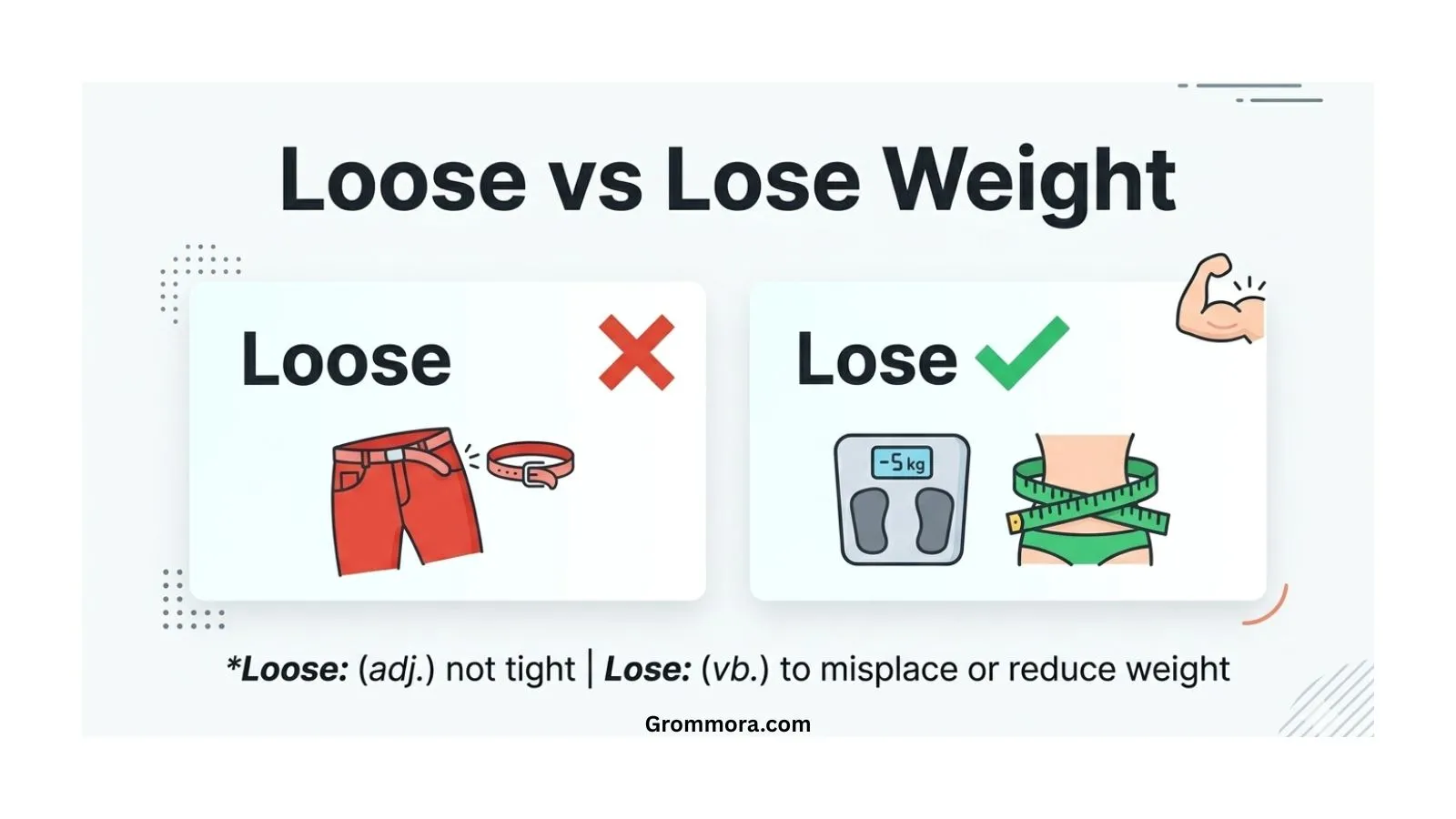
Many people search “loose or lose weight” because the two words look almost the same. They differ by just one letter. But their meanings are very different. This small spelling mistake appears everywhere—blogs, emails, social media posts, and even ads.
If you search online for weight loss tips, you might see sentences like “How to loose weight fast.” The problem is that “loose” is the wrong word in this case. The correct phrase is “lose weight.” When writers confuse these words, it can make content look unprofessional and confusing.
|See more Quiet Or Quite
This article solves that confusion. You will learn the correct spelling, meaning, and usage of “loose” and “lose.” We will also explain where these words came from, how they differ in spelling rules, and when to use each one.
By the end, you will know exactly which word to use when talking about weight loss and in everyday writing.
Loose or Lose Weight – Quick Answer
The correct phrase is “lose weight.”
- Lose = to reduce something or no longer have it.
- Loose = not tight or not firmly fixed.
Examples
Correct:
- I want to lose weight before summer.
- She is trying to lose weight by exercising.
Incorrect:
- I want to loose weight.
Other examples of loose:
- My shirt is loose.
- The dog is loose in the yard.
Quick Comparison
| Word | Meaning | Example |
|---|---|---|
| Lose | To reduce or no longer have | I want to lose weight. |
| Loose | Not tight | These jeans are loose. |
The Origin of Loose or Lose Weight
The words lose and loose come from Old English, but they developed different meanings.
Lose comes from the Old English word “losian.” It meant to perish, be destroyed, or stop having something. Over time, it evolved into the modern meaning: to no longer have something.
Loose comes from the Old English word “los.” It meant free, not bound, or not tight.
Because both words come from related roots, they look similar today. But English spelling kept both forms to represent different sounds and meanings.
Pronunciation also helps distinguish them:
- Lose → sounds like “looz”
- Loose → sounds like “loose”
That sound difference explains why the spellings remain separate.
British English vs American English Spelling
For the phrase “lose weight,” there is no spelling difference between British and American English. Both use the same word: lose.
However, spelling confusion still happens because “loose” is a common English word.
Examples in Both Variants
- American English: Doctors say exercise helps people lose weight.
- British English: A healthy diet helps you lose weight.loose or lose weight
Comparison Table
| Meaning | Correct Word | Example |
|---|---|---|
| Reduce body weight | Lose | She wants to lose weight. |
| Not tight | Loose | The rope is loose. |
So regardless of location—USA, UK, Canada, Australia, or India—the correct phrase is lose weight.
Which Spelling Should You Use?
Always use “lose weight.”
But writing style can depend on your audience.
If Your Audience Is in the United States
Use lose weight.
Example: How to lose weight fast.
If Your Audience Is in the UK or Commonwealth
Use lose weight.
Example: Healthy ways to lose weight naturally.
If Your Audience Is Global
Use lose weight and keep sentences simple. This helps readers and improves SEO.
Remember:
“Loose weight” is always incorrect.
Common Mistakes with Loose or Lose Weight
Many writers confuse these two words.
Mistake 1
❌ How to loose weight fast
✔ How to lose weight fast
Mistake 2
❌ Tips to loose belly fat
✔ Tips to lose belly fat
Mistake 3
❌ She wants to loose 10 pounds
✔ She wants to lose 10 pounds
Simple Memory Trick
- Lose has one “o” → You lose something.
- Loose has two “o’s” → Something wide or not tight.
Loose or Lose Weight in Everyday Examples
You may see these words in many types of writing.
Email Example
Correct:
I want to lose weight before my wedding.
Incorrect:
I want to loose weight before my wedding.
News Example
Correct:
Doctors recommend exercise to help people lose weight safely.
Social Media Example
Correct:
My goal this year is to lose weight and stay healthy.
Formal Writing Example
Correct:
A balanced diet can help individuals lose weight gradually.
Loose or Lose Weight – Google Trends & Usage Data
Search data shows that many people type “loose weight.” This happens because:
- The words look similar.
- People type quickly on phones.
- Many non-native English speakers confuse the spelling.
However, search engines recognize that “loose weight” usually means “lose weight.”
Popular Countries Searching the Phrase
- United States
- United Kingdom
- India
- Pakistan
- Canada
In SEO content, the correct phrase “lose weight” is used far more often.
Keyword Variation Table
| Keyword Variation | Correct or Incorrect | Notes |
|---|---|---|
| lose weight | Correct | Standard phrase |
| loose weight | Incorrect | Common typo |
| how to lose weight | Correct | Popular search |
| fast weight loss | Correct | Related keyword |
FAQs About Loose or Lose Weight
Which is correct, loose or lose?
Lose means to no longer have something, while loose means not tight. The correct word depends on the sentence.
|See also Till Or Til
Do you loose or lose a person?
You lose a person (meaning you no longer have them or they are gone). “Loose” is incorrect here.
What are signs your body is losing weight?
Common signs include looser clothes, reduced body measurements, and gradual changes on the scale.
Is it lose or loose for clothing?
Use loose for clothing because it means not tight.
Is it loose or lose weight?
The correct phrase is lose weight, meaning to reduce body weight.
Why do people say “loose” instead of “lose”?
People confuse them because the words look similar in spelling, even though they have different meanings.
Conclusion
The confusion between “loose” and “lose” is common because the words look similar. But their meanings are very different.
The correct phrase is always “lose weight.” The word lose means to reduce or no longer have something. When people talk about dieting, fitness, or health goals, they use this word.
On the other hand, loose means something is not tight. It can describe clothing, ropes, or objects that are free or relaxed. Because of this meaning, it does not fit in the phrase about reducing body weight.
Both American and British English use the same spelling—“lose weight.” So you can safely use it for audiences anywhere in the world.
To avoid mistakes, remember this simple rule:
If you are talking about reducing body weight, always write “lose weight.”
Using the correct spelling improves clarity, professionalism, and SEO performance.