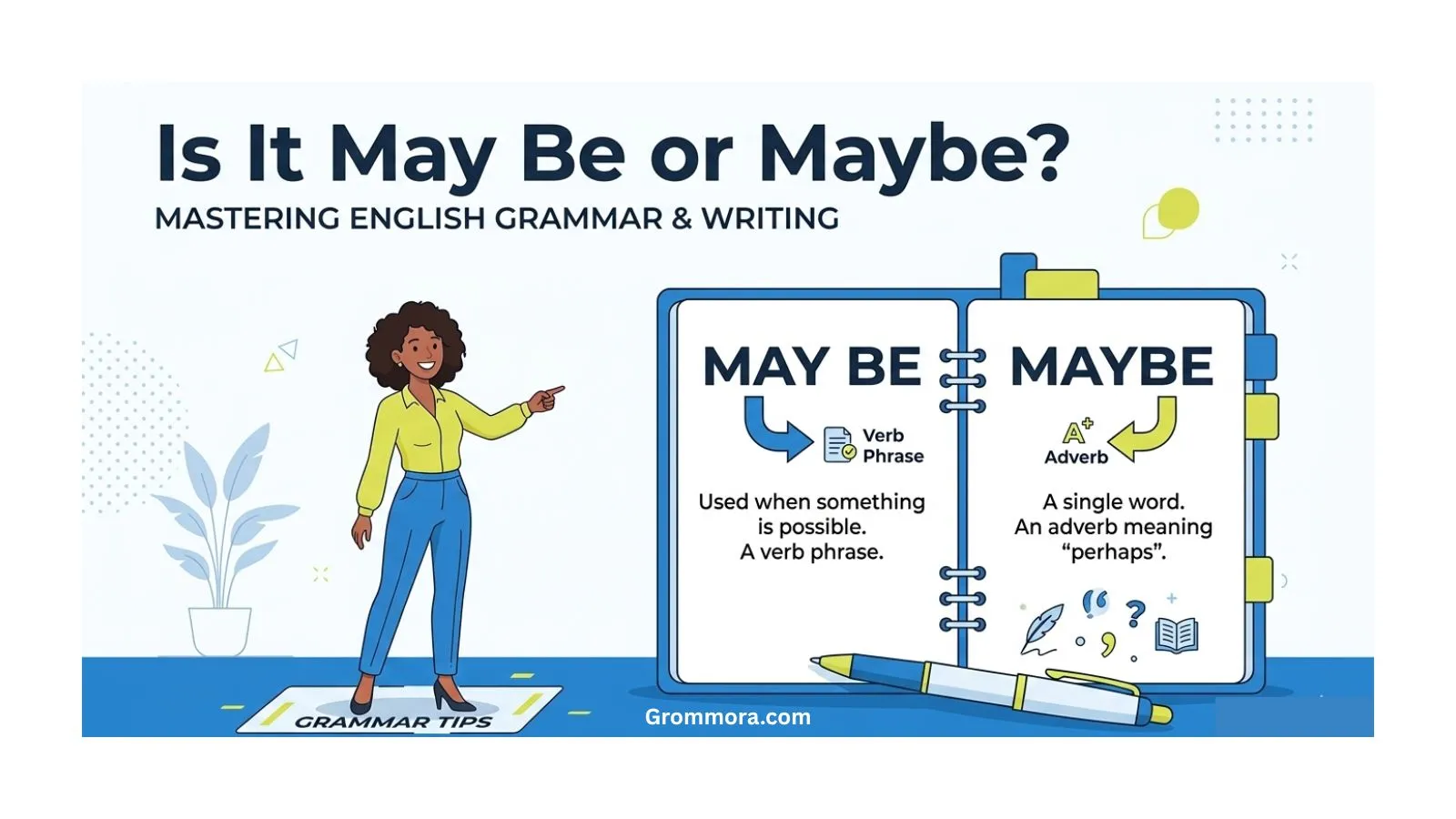
Many English learners and writers often ask: “Is it may be or maybe?” The confusion happens because the two forms look similar but serve different grammatical roles. One is a phrase, and the other is an adverb. Because they sound the same in speech, people frequently mix them up when writing emails, social posts, essays, or professional messages.
|See also To Or Too
Search engines receive thousands of queries every month about this exact question. Writers want to know which version is correct and when each one should be used. The mistake can make sentences unclear or unprofessional, especially in formal writing.
This article solves that confusion in a simple way. You will learn the quick rule, the history of the words, the differences in usage, and real examples. We will also cover common mistakes and how different English-speaking regions use the words.
By the end, you will know exactly when to write “may be” and when to use “maybe.”
Is It May Be or Maybe? – Quick Answer
The difference is simple:
- Maybe = an adverb meaning perhaps or possibly
- May be = a verb phrase meaning might be
Examples
| Word | Example | Meaning |
|---|---|---|
| Maybe | Maybe we will go to the park. | Perhaps |
| May be | She may be late today. | Might be |
Quick Trick
Replace the word with “perhaps.”
- If the sentence still works → use maybe
- If not → use may be
Example:
- Maybe it will rain today. → Perhaps it will rain today. ✔
- She may be tired after work. → She perhaps tired ❌
So here may be is correct.
The Origin of “May Be or Maybe”
The two forms share the same root.
The word “may” comes from Old English “magan.” It meant to have power or possibility. Over time, English speakers used it to show possibility or permission.
Originally, “may be” was simply the verb may + be.
Example from early English:
- It may be true.
Later, English speakers combined the words into “maybe.” This created a single adverb meaning perhaps.
So today:
- May be → verb phrase
- Maybe → adverb
This change is common in English. Many words began as two words and later became one.
British English vs American English Spelling
Good news: Both British and American English use the same spelling rules for maybe and may be. The difference is not regional but grammatical.
Comparison Table
| Form | Type | Example | Meaning |
|---|---|---|---|
| Maybe | Adverb | Maybe she will call later. | Perhaps |
| May be | Verb phrase | She may be busy now. | Might be |
Regional Example Sentences
| Region | Sentence |
|---|---|
| US English | Maybe we should leave early. |
| UK English | Maybe it will snow tonight. |
| US English | He may be the right person. |
| UK English | The answer may be correct. |
As you can see, both regions follow the same rule.
Which Spelling Should You Use?
The correct choice depends on sentence structure, not location.
Use Maybe When:
- You mean perhaps
- It starts a sentence often
Example:
- Maybe we should try again.
- Maybe they forgot the meeting.
Use May Be When:
- You describe possibility
- It follows a subject
Example:
- He may be tired.
- The result may be wrong.
Advice by Audience
| Audience | Recommendation |
|---|---|
| US Writers | Follow grammar rule: maybe vs may be |
| UK Writers | Same rule applies |
| Global Content | Use correct grammar for clarity |
Professional writing requires choosing the correct form.
Common Mistakes with “May Be or Maybe”
Many writers accidentally mix the two.
Mistake 1
❌ Maybe she late today.
✔ She may be late today.
Mistake 2
❌ She maybe tired.
✔ She may be tired.
Mistake 3
❌ May be we should start early.
✔ Maybe we should start early.
Quick Fix Rule
If the sentence already has a subject, you likely need may be.
“May Be or Maybe” in Everyday Examples
Emails
- Maybe we can meet tomorrow.
- The file may be missing.
News Writing
- Maybe the policy will change next year.
- The results may be delayed.
Social Media
- Maybe I will watch that movie tonight.
- This may be the best café in town.
Formal Writing
- The results may be influenced by weather.
- Maybe future studies will explain this trend.
“May Be or Maybe” – Google Trends & Usage Data
Search data shows that “maybe” is far more common than “may be.”
Why?
Because maybe is used in everyday conversation and casual writing.
Popularity by Region
| Country | Common Usage |
|---|---|
| United States | maybe used heavily in conversation |
| United Kingdom | similar usage |
| Canada | same grammar rules |
| Australia | maybe widely used |
However, “may be” appears more in formal writing, research papers, and professional documents.
Comparison Table: Keyword Variations
| Phrase | Grammar Type | Meaning | Example |
|---|---|---|---|
| Maybe | Adverb | Perhaps | Maybe I will go. |
| May be | Verb phrase | Might be | It may be true. |
| Perhaps | Adverb | Possibly | Perhaps we should wait. |
FAQs
What is the difference between probably and may be?
Probably means something is likely to happen, while may be means something is possible but less certain.
What is the difference between may be and might be?
Both show possibility, but might be suggests a slightly weaker or less certain possibility than may be.
What is the difference between maybe and could be?
Maybe means perhaps, while could be suggests a possible explanation or situation.
Is it correct to say “maybe”?
Yes, maybe is correct and commonly used as an adverb meaning perhaps.
When to say “maybe” or “may be”?
Use maybe when you mean perhaps, and use may be when describing something that might be true.
What are common mistakes with may be maybe?
A common mistake is writing maybe instead of may be in sentences like “She maybe tired,” which should be “She may be tired.”
Conclusion
The difference between “may be” and “maybe” is simple once you know the rule. Even though they sound the same, they play different roles in grammar.
Use maybe when you mean perhaps. It works as an adverb and often appears at the beginning of a sentence. For example: Maybe we will visit tomorrow.
Use may be when you talk about possibility. It is a verb phrase made of may + be. For example: The meeting may be canceled.
A quick test helps: replace the word with perhaps. If the sentence still makes sense, use maybe.
Both British and American English follow the same rule, so you do not need to change spelling based on region.
By remembering this simple difference, your writing will become clearer, more professional, and easier to understand. Whether you are writing emails, articles, or social posts, choosing the correct form helps you communicate accurately.