
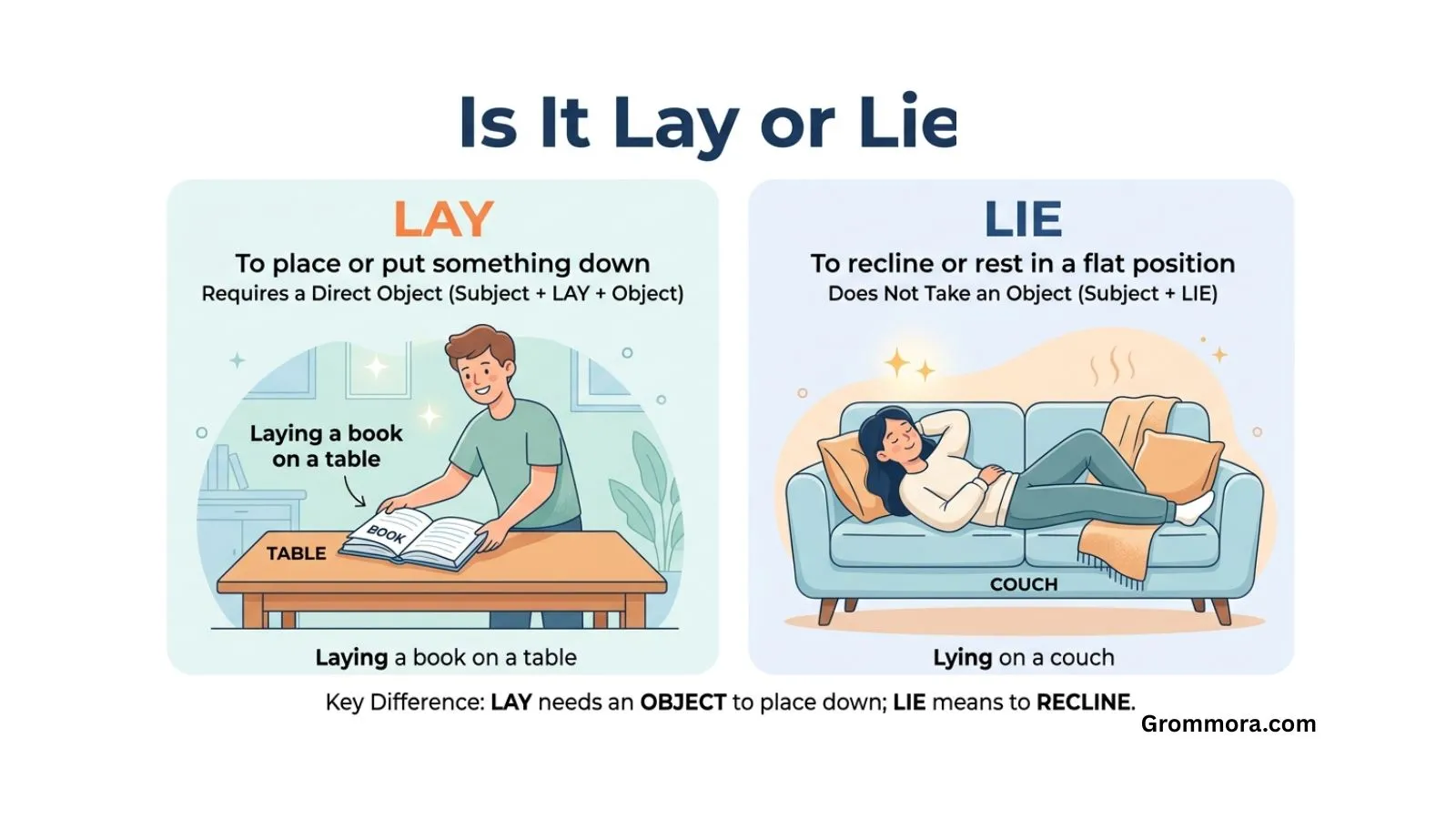
Many people search for “is it lay or lie” because these two words cause a lot of confusion. They look similar. They sound similar. But they do not mean the same thing.
|See more Is Break Room One Word
You may ask questions like:
- For example, should I say “lay down” or “lie down”?
- In addition, is it “I was laying in bed” or “I was lying in bed”?
- Finally, which one is correct in writing?
This confusion happens because the past forms of these verbs overlap. For example, lay can also be the past tense of lie. That makes it hard to know which word to use.
Fortunately, the good news is that the rule is simple once you understand it. In fact, one verb needs an object, while the other does not.
In this guide, you will learn:
- First, the quick rule for lay vs lie
- Next, the history of these words and how they developed
- Then, common mistakes people often make
- After that, real-life examples in emails and everyday writing
- Finally, which form you should use with confidence
By the end, you will know exactly when to use lay and when to use lie.
Is It Lay or Lie? – Quick Answer
Short rule:
| Word | Meaning | Example |
|---|---|---|
| Lay | Put something down | I lay the book on the table. |
| Lie | Rest or recline | I lie on the sofa. |
Easy trick
- Lay = put something down (needs an object)
- Lie = rest yourself (no object)
Examples
Correct:
- Please lay the phone on the desk.
- I want to lie down and sleep.
Incorrect:
- ❌ I will lay down for a nap.
- ✔ I will lie down for a nap.
Another example:
- Afterwards, she laid the keys on the table, while he lay on the beach all day.
- Meanwhile, she laid the keys on the table, and at the same time, he lay on the beach all day.
The key idea: Lay affects something. Lie does not.
The Origin of Lay or Lie
The confusion between lay and lie comes from their long history in English.
Both words come from Old English.
- Lie comes from the Old English word “licgan.”
It meant to rest or recline. - Lay comes from “lecgan.”
It meant to place or put something down.
Over time, the grammar changed. But the past forms stayed similar.
For example:
| Verb | Present | Past | Past Participle |
|---|---|---|---|
| Lie | lie | lay | lain |
| Lay | lay | laid | laid |
This overlap is why people often say:
❌ I was laying on the bed.
But the correct form is:
✔ I was lying on the bed.
The verbs kept their old forms; consequently, this created today’s confusion.
British English vs American English Spelling
Additionally, for lay vs lie, there is no spelling difference between British and American English.
Both regions use the same spellings and rules.
However, usage patterns can vary in casual speech.
Comparison Table
| Feature | American English | British English |
|---|---|---|
| Lay spelling | lay | lay |
| Lie spelling | lie | lie |
| Formal grammar rules | Same | Same |
| Casual misuse | Common | Common |
Examples used in both regions:
- I will lie down for a while.
- She laid the papers on the desk.
So the rule is universal across English dialects.
Which Spelling Should You Use?
Choosing between lay and lie depends on sentence structure, not region.
If you are writing for a US audience
Use standard grammar:
- Lie down
- Lay the object
Example:
“Please lay the report on my desk.”
If you are writing for UK or Commonwealth readers
The same rules apply.
Example:
“I need to lie down after work.”
If you write for a global audience
Use the standard grammar rule.
Ask yourself one question:
Is there an object?
- If yes → lay
- If no → lie
Example:
- Lay the bag here.
- Lie here and rest.
Common Mistakes with Lay or Lie
Many people mix these words in everyday speech.
Mistake 1
❌ I am laying on the couch.
✔ I am lying on the couch.
Reason: No object.
Mistake 2
❌ I will lie the book on the desk.
✔ I will lay the book on the desk.
Reason: You are placing something.
Mistake 3
❌ She laid on the bed all day.
✔ She lay on the bed all day.
Reason: Past tense of lie is lay.
Quick Correction Table
| Wrong | Correct |
|---|---|
| laying on bed | lying on bed |
| lie the phone down | lay the phone down |
| laid on sofa | lay on sofa |
Lay or Lie in Everyday Examples
Here is how these verbs appear in real life writing.
Emails
Correct:
- “Please lay the documents on my desk.”
News Writing
Example sentence:
- “The injured player lay on the field for several minutes.”
Social Media
Common casual use:
❌ “I’m just laying in bed today.”
✔ “I’m just lying in bed today.”
Formal Writing
Example:
- “The nurse asked the patient to lie down.”
Another example:
- “The technician laid the equipment on the table.”
Lay or Lie – Google Trends & Usage Data
Consequently, search interest for ‘is it lay or lie’ is high around the world, as many English learners and even native speakers frequently look up this rule.
Popular Regions Searching the Topic
Common search locations include:
- United States
- United Kingdom
- Canada
- Australia
- India
Why People Search It
Users often search this phrase when they write:
- Emails
- School essays
- Social media posts
- Professional documents
The biggest confusion comes from this pattern:
Present: lie
Past: lay
Because of this overlap, people often double-check the rule online.
Lay vs Lie Comparison Table
| Verb | Meaning | Needs Object | Example |
|---|---|---|---|
| Lay | Put something down | Yes | Lay the book here |
| Lie | Rest or recline | No | Lie on the bed |
Verb Forms
| Verb | Present | Past | Past Participle |
|---|---|---|---|
| Lie | lie | lay | lain |
| Lay | lay | laid | laid |
FAQs About Lay or Lie
Do I lie in bed or lay in bed?
Correct: lie in bed because you are resting yourself. Lay needs an object.
Is it here I lie or here I lay?
Correct: here I lie for present tense. Here I lay would mean past tense.
Do you lay or lie on the couch?
Correct: lie on the couch because no object is involved.
Is it my dog is lying or laying?
Correct: my dog is lying because the dog is resting, not placing something.
Is lie or lay correct?
Both are correct. Lay means put something down; lie means rest.
Do I lie in the sun or lay in the sun?
Correct: lie in the sun because you are reclining yourself.
Conclusion
The question “is it lay or lie” often confuses many English speakers because the words look similar and, moreover, share overlapping verb forms. But the rule itself is simple.
Lay means to put something down. In other words, it always needs an object.
For example:
“Lay the book on the table.”
On the other hand, lie means to rest or recline. Unlike lay, it does not need an object.
For instance:
“I want to lie down.”
Most mistakes happen because the past tense of lie is Put. This overlap makes sentences tricky. But you can avoid confusion with one simple check:
Ask: Is something being placed?
- Yes → use lay
- No → use lie
With practice, this rule becomes natural. Whether you write emails, articles, or social media posts, using Put and lie correctly will make your English clearer and more professional.