
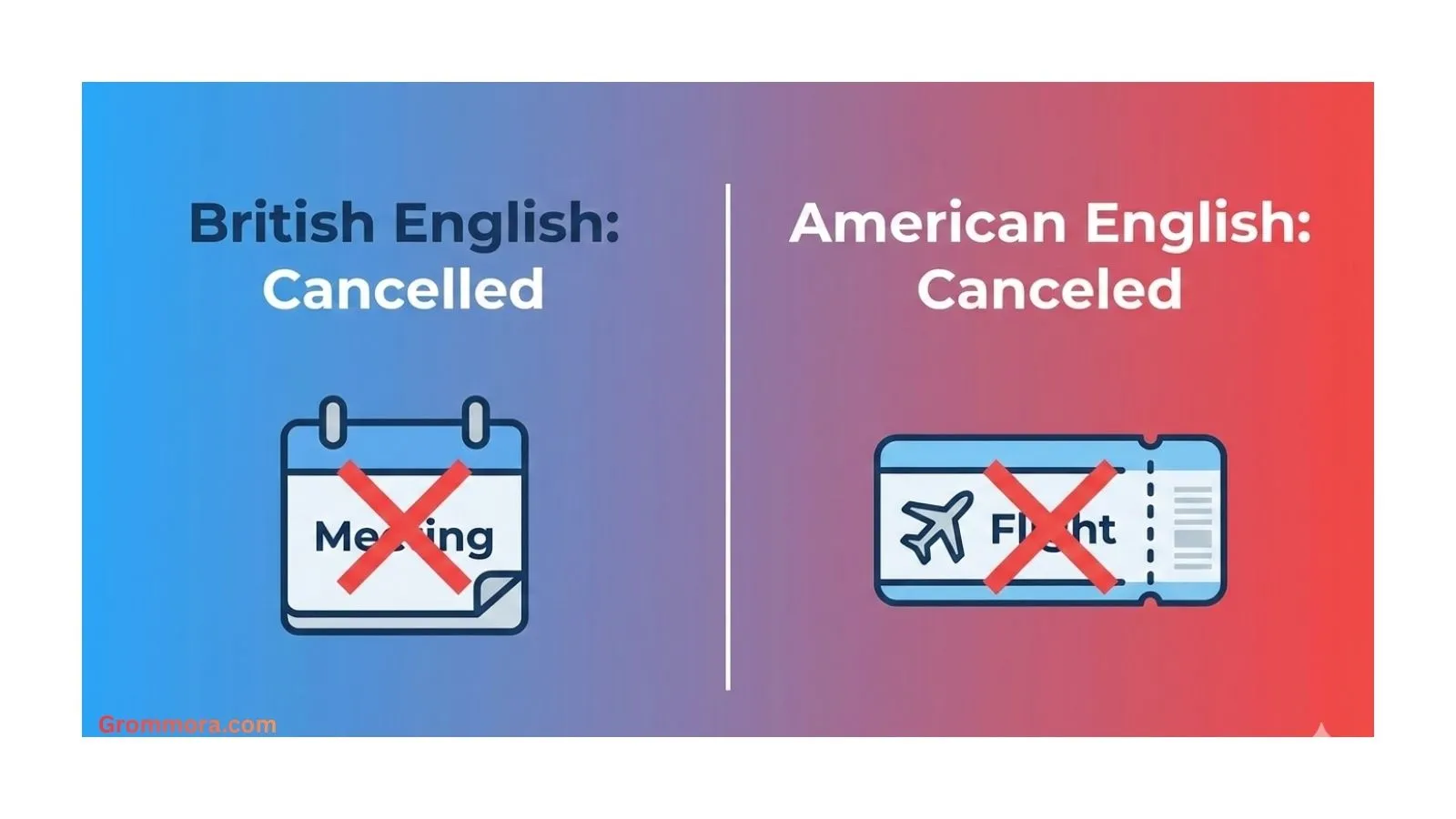
Have you ever typed an email and paused at this word: is it cancelled or canceled? If you have, you share this confusion with many other writers.” Consequently, thousands of people search this every month. Naturally, the confusion is real. In fact, both spellings look correct. Both appear in books, news, and online posts. So which one should you use?
This spelling problem happens because English has two major versions: British English and American English. Each follows slightly different spelling rules. That small difference creates big confusion, especially for students, writers, bloggers, and professionals who want to sound correct.
In this guide, you will get a clear answer fast. Then we will explore the history, spelling rules, examples, common mistakes, and usage trends. By the end, you will know exactly when to use cancelled and when to use canceled with confidence.
is it cancelled or canceled – Quick Answer
Both are correct.
- Canceled → American English spelling
- Cancelled → British English spelling
Examples:
- The meeting was canceled. (US English)
- The meeting was cancelled. (UK English)
The meaning is the same: something was called off or stopped.
The only difference is the number of “L” letters.
The Origin of is it cancelled or canceled?
The word cancel comes from the Latin word cancellare, which means “to cross out.”
It entered English through Old French. Over time, spelling rules changed.
In American English, spelling was simplified in the 1800s. Many words dropped extra letters. For example:
- Colour → Color
- Travelling → Traveling
- Cancelled → Canceled
American dictionary reformers like Noah Webster strongly influenced this simplification because they wanted American spelling to be shorter and simpler.
British English kept the traditional double “L” form.
That is why both spellings exist today.
British English vs American English Spelling
Here is how the spelling rule works:
In British English, verbs ending in a vowel + “L” usually double the “L” before adding “-ed” or “-ing.”
In American English, writers double the “L” only if the stress falls on the last syllable.
Examples
| Base Word | American English | British English |
|---|---|---|
| Cancel | Canceled | Cancelled |
| Travel | Traveled | Travelled |
| Model | Modeled | Modelled |
Quick Comparison Table
| Version | Preferred Spelling | Countries |
|---|---|---|
| American English | Canceled | United States |
| British English | Cancelled | UK, Canada, Australia, India |
Both forms are grammatically correct. The difference is regional style.
Which Spelling Should You Use?
It depends on your audience.
Use Canceled if:
- You write for an American audience
- Your company follows US style guides
- You use AP Style
Use Cancelled if:
- You write for the UK or Commonwealth countries
- Your organization follows British English
- You are writing academic papers in UK style
If Your Audience Is Global
Choose one spelling and stay consistent. Consistency matters more than the version you choose.
Common Mistakes with is it cancelled or canceled?
Here are frequent errors:
1. Mixing both spellings in the same document
✔ The organizers canceled the event. They later cancelled it again. (Active)
✔ Choose one version and stick to it.
2. Thinking one is wrong
Both are correct. The difference is regional.
3. Misspelling both
Common wrong forms:
- Cancelleded
- Cancelleded
- Cancellled
Only use:
- Canceled
- Cancelled
Is It Cancelled or Canceled? in Everyday Examples
Here is how the word appears in real life.
In Emails
- ✔ “We have canceled the appointment.” (US)
- “We have cancelled your order.”(UK)
In News Headlines
- “Flight Canceled Due to Storm.” (US publication)
- “Train Services Cancelled After Flooding.” (UK publication)
On Social Media
- “The show got cancelled 😢”
- “Why did they cancel the event?” ✅
In Formal Writing
- “The company canceled the contract due to a breach of terms.”
- “The company cancelled the subscription after the customer failed to pay.”
Both forms mean the same thing.
is it cancelled or canceled? – Google Trends & Usage Data
Search data shows a clear regional pattern:
- Canceled is dominant in the United States.
- Cancelled is more popular in the UK, Canada, Australia, and India.
In global searches, both versions appear frequently. However, American English has a strong online presence, so “canceled” often appears slightly more worldwide.
Usage Comparison
| Country | More Common Spelling |
|---|---|
| United States | Canceled |
| United Kingdom | Cancelled |
| Canada | Cancelled |
| Australia | Cancelled |
| India | Cancelled |
The difference is about geography, not correctness.
Keyword Comparison Table
| Word Form | American English | British English |
|---|---|---|
| Present | Cancel | Cancel |
| Past Tense | Canceled | Cancelled |
| Continuous | Canceling | Cancelling |
| Noun | Cancellation | Cancellation |
Both versions spell ‘cancellation’ with double ‘L’.” ✅
FAQs
Which spelling is correct, cancelled or canceled?
Both are correct; canceled is American English, cancelled is British English.
Does the double L matter in cancellation?
No, cancellation always uses double “L” in both US and UK English.
Is it canceled or cancelled Merriam Webster?
Merriam-Webster lists canceled as the standard American spelling.
Is it cancelled or canceled in the USA?
In the USA, canceled with one “L” is preferred.
Why do Americans spell it canceled?
American English simplified many words in the 1800s, dropping extra letters like the double “L.”
Is canceled with one L or two L’s?
Use canceled (one L) in American English and cancelled (two Ls) in British English.
Why did Taylor spell cancel with two L’s?
She followed British English rules, which double the “L” in past tense.
When to use double L in a word?
Double “L” is used in British English when a verb ends in a vowel + L before adding -ed or -ing.
Does the NY Times use canceled or cancelled?
The NY Times uses canceled, following American English style.
Conclusion
Is it cancelled or canceled? Clearly, both spellings are correct, but the choice depends on your audience. For instance, use canceled when writing for Americans, while cancelled works best for readers in the UK and other Commonwealth countries. Moreover, the meaning remains the same; only the spelling differs. Therefore, consistency is key—choose one version and stick with it throughout your document. Additionally, understanding this difference can help you avoid common mistakes in emails, articles, and formal writing. Ultimately, knowing when and where to use each form makes your writing clear, professional, and globally appropriate.