
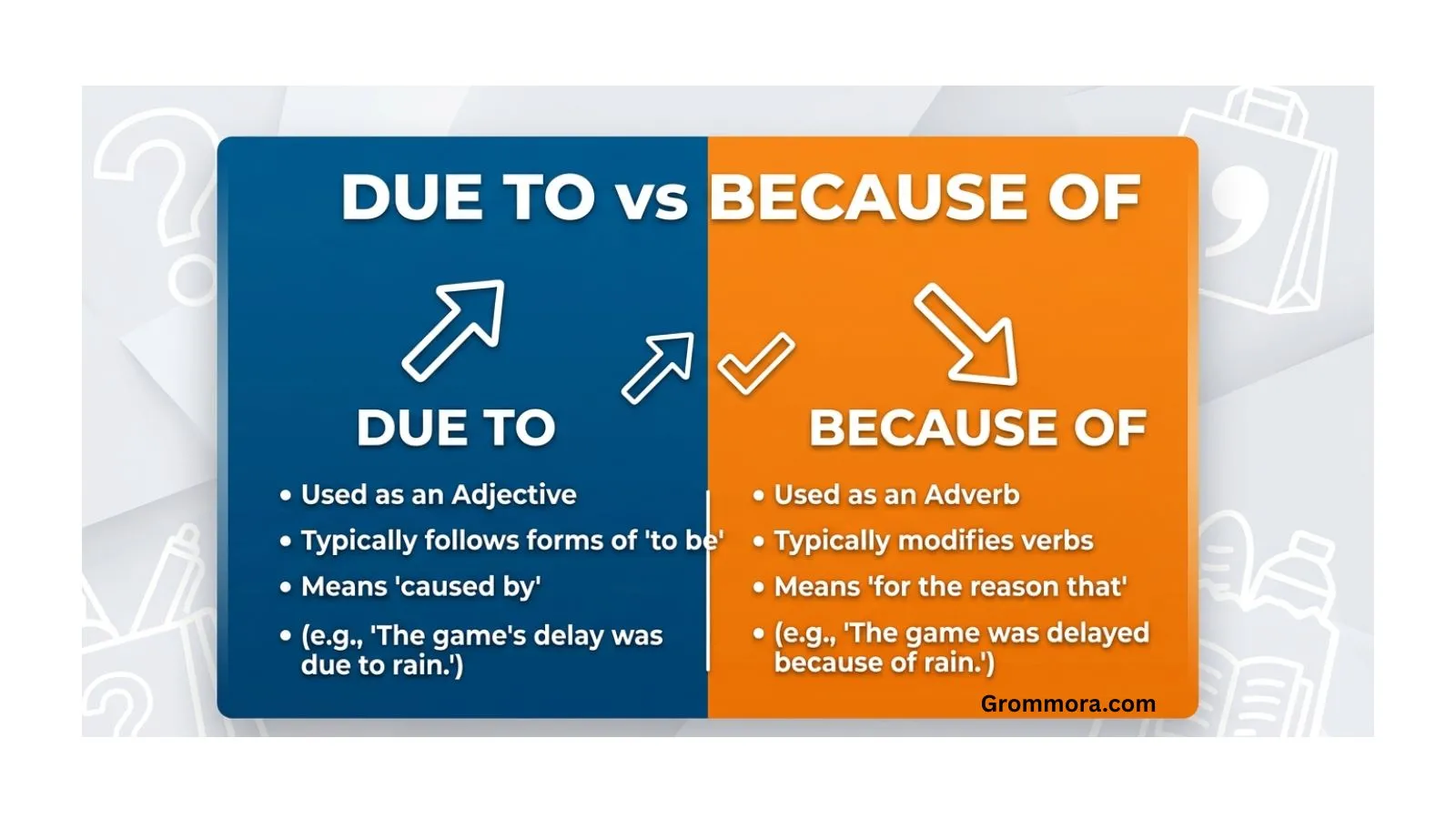
Many people search for “due to vs because of” because these two phrases look similar but are not always used the same way. Both mean “for a reason”, yet they follow different grammar rules. This creates confusion, especially in writing emails, essays, or professional documents.
|See more Dialog Or Dialogue
You might wonder: Can I use them interchangeably? Which one is correct? The answer is not always simple. While modern usage often mixes them, traditional grammar treats them differently. Using the wrong one can make your writing sound awkward or less formal.
This guide will clear up the confusion. You’ll learn the exact difference, simple rules, and real-life examples. By the end, you’ll know when to use “due to” and when to use “because of” with confidence.
Due To vs Because Of – Quick Answer
Short answer:
- Use “due to” after a form of “to be” (is, are, was, were).
- Use “because of” to explain why something happens.
Examples:
- The delay was due to heavy rain. ✅
- The flight was canceled because of fog. ✅
Quick tip:
If you can replace it with “caused by”, use due to.
The Origin of Due To vs Because Of
“Due to” comes from older English and was first used as an adjective phrase. It means ‘attributable to’ or ‘caused by.’ Writers often used it in formal writing.
“Because of” is more direct. It comes from combining:
- “because” (reason)
- “of” (connection)
Over time, people started using both phrases more freely. Today, in casual English, they often overlap. But in formal grammar, the difference still matters.
British English vs American English Spelling
Good news: there is no spelling difference between British and American English for these phrases. Both use:
- “due to”
- “because of”
However, usage style differs slightly. British English often sticks more to traditional grammar rules, while American English is more flexible.
Comparison Table
| Feature | British English | American English |
|---|---|---|
| Grammar strictness | More strict | More flexible |
| “Due to” usage | Mostly after “to be” verbs | Used more freely |
| “Because of” usage | Preferred for clarity | Common in all contexts |
Which Spelling Should You Use?
Since spelling is the same, focus on your audience:
- US audience: You can use both more freely.
- UK/Commonwealth: Follow strict rules (use “due to” carefully).
- Global audience: Use “because of” for clarity.
Best advice:
When unsure, use “because of”. It is clear and always correct.
Common Mistakes with Due To vs Because Of
❌ Incorrect:
- The game was canceled due to it was raining.
✔ Correct: The game was canceled because of rain.
Incorrect:
- Due to he was late, we started without him.
✔ Correct: Because of his delay, we started without him.
❌ Incorrect:
- She missed class because of she was sick.
✔ Correct: She missed class because she was sick.
Key Rule:
- “Due to” + noun
- “Because of” + noun
- “Because” + clause (subject + verb)
Due To vs Because Of in Everyday Examples
Emails
- The meeting is postponed due to technical issues.
- The event was delayed because of traffic.
News
- Flights canceled due to weather conditions.
- Schools closed because of heavy snow.
Social Media
- Late post because of bad internet 😅
- Event canceled due to rain.
Formal Writing
- The error occurred due to system failure.
- The results changed because of new data.
Due To vs Because Of – Google Trends & Usage Data
Search trends show that “because of” is more common worldwide. It is simple and easy to understand.
- United States:
- Both are popular, but “because of” is slightly higher.
- United Kingdom:
- “Due to” appears more in formal writing.
- Global usage:
- “Because of” dominates in everyday English.
Why?
Because it is clearer and works in almost every sentence.
Comparison Table: Due To vs Because Of
| Feature | Due To | Because Of |
|---|---|---|
| Grammar role | Adjective phrase | Prepositional phrase |
| Use case | After “to be” verbs | Shows reason |
| Formality | More formal | Neutral |
| Flexibility | Less flexible | Very flexible |
| Example | Delay was due to rain | Delay happened because of rain |
FAQs
1. What is the difference between due to and because of?
“Due to” follows a verb (like is/was), while “because of” explains the reason for something.
2. Why not to use due to?
Avoid it when grammar doesn’t fit; it can sound wrong or too formal.
3. What is a common mistake with due to?
Using it before a full sentence instead of a noun (e.g., due to he was late ❌).
4. How to use due in a sentence?
Use it after “to be” verbs: The delay was due to rain.
5. Is due to the same as because?
No, but they are similar; “because of” is more flexible.
6. Why does Gen Z say no because?
It’s slang meaning “no, for obvious reasons” without explanation.
Conclusion
Understanding “due to vs because of” is simple once you know the basic rule. “Due to” works best after forms of the verb “to be” and acts like an adjective. “Because of” explains reasons and is more flexible in everyday use.
While modern English often mixes the two, clear writing still benefits from using them correctly. If you are writing formally, follow the traditional rules. If your goal is clarity, especially for a global audience, “because of” is usually the better choice.
In the end, both phrases are useful. The key is knowing when each fits best. With practice, choosing the right one will feel natural and improve your writing instantly.