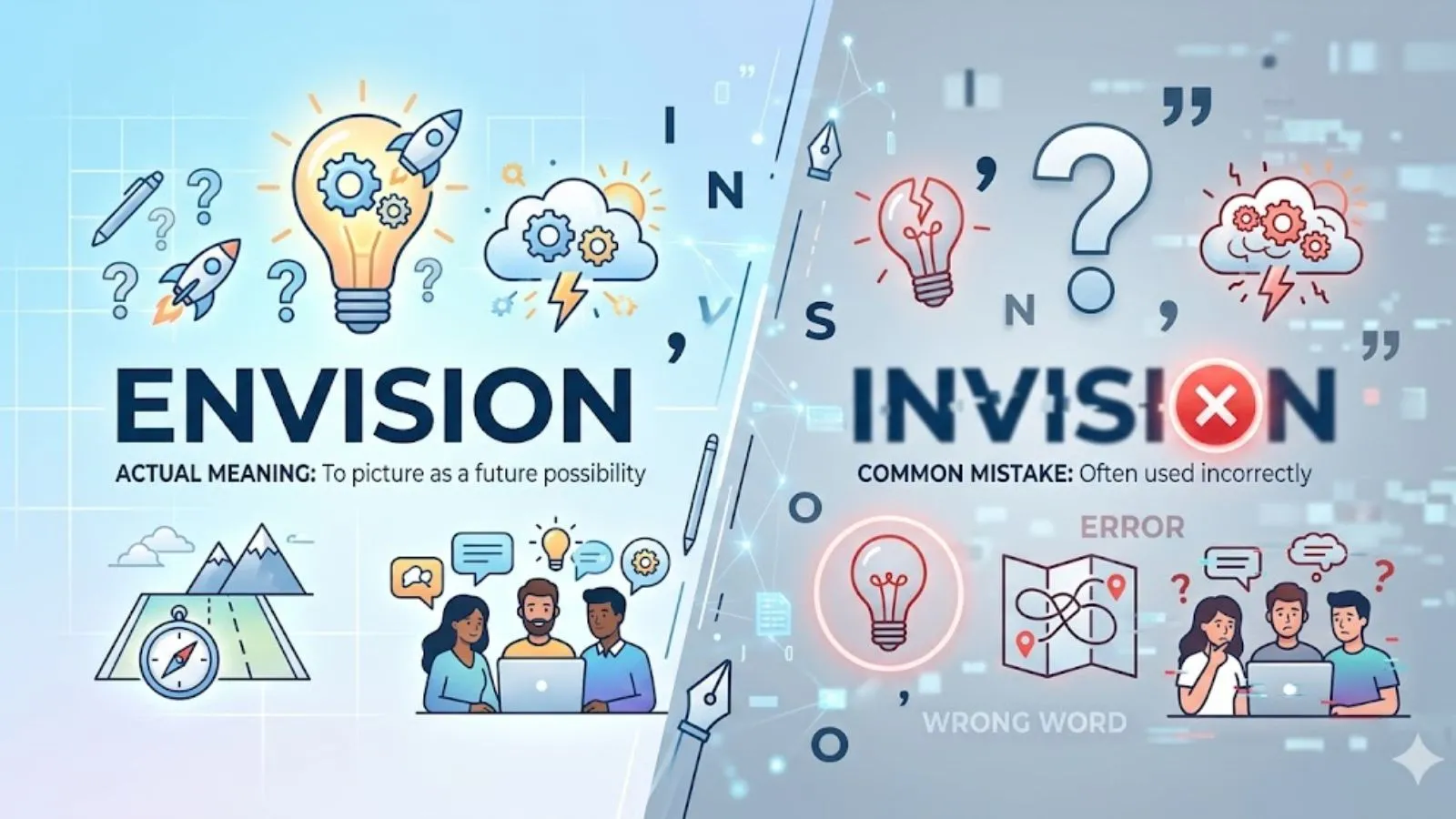
Have you ever seen the words Invision or Envision and felt confused about which one is correct? You are not alone. Many people mix these two words while writing emails, blogs, or even social media posts. Although they look similar, their meanings and usage are very different.
|RELATED: Peice or Piece
What Does Invision or Envision Mean?
To understand Invision or Envision, we must first break them down separately.
What is “Envision”?
Envision is a real English word. It means to imagine, plan, or picture something in your mind for the future.
Example:
- She can envision her future as a successful doctor.
- We envision a better world with clean energy.
So, envision is about imagination and future thinking.
What is “Invision”?
Invision is often a misspelling or brand name. It is not a standard English verb. However, it is also used as a company name (for example, design or tech platforms).
In normal grammar usage, Invision is incorrect when used instead of Envision.
Incorrect Example:
- I invision a bright future. ❌
Correct Version:
- I envision a bright future. ✔
Therefore, when comparing Invision or Envision, the correct English word is always “envision.”
Core Difference Between Invision or Envision
Understanding the core difference between Invision or Envision helps you avoid writing mistakes.
- Envision = correct verb meaning to imagine or plan
- Invision = incorrect spelling in standard English (except as a proper noun/brand)
Moreover, many learners confuse both because they sound similar. However, only one is accepted in formal writing.
Simple Rule:
If you are talking about imagination or planning, always use envision, not invision.
Why One Form is Correct and the Other is Incorrect
The confusion between Invision or Envision comes from pronunciation and typing errors.
1. Language Origin
The word envision comes from Latin roots related to “seeing in the mind.” Therefore, it carries the meaning of mental visualization.
2. Spelling Structure
- “En-” means to put into or cause
- “Vision” means sight or imagination
When combined, envision = to form a vision in the mind
However, “invision” does not follow correct English word formation rules.
3. Common Mistake in Writing
People often type “invision” because:
- It sounds like “in vision”
- Keyboard errors
- Mishearing the word
Therefore, Invision or Envision confusion is mostly spelling-based, not meaning-based.
Comparison Table: Invision vs Envision
| Feature | Envision | Invision |
|---|---|---|
| Grammar status | Correct word | Incorrect spelling (in general use) |
| Meaning | To imagine or plan | No standard meaning |
| Usage | Formal writing, speech | Only as brand/name |
| Example | I envision success | I invision success (wrong) |
Usage of Envision in Real Life
Understanding Invision or Envision becomes easier when we see real-life examples.
1. Blogging and Content Writing
Writers often use envision to describe future ideas.
Example:
- Bloggers envision growth in their website traffic through SEO.
2. Education
Students use envision in essays and academic writing.
Example:
- Teachers encourage students to envision their career goals.
3. Business and Marketing
In business, envision is widely used in strategy planning.
Example:
- The company envisions expanding into international markets.
4. Technology and Design
Even in tech discussions, envision plays an important role.
Example:
- Developers envision a user-friendly app experience.
However, if you see “InVision” in tech, it may refer to a brand name, not the verb.
Common Mistakes to Avoid with Invision or Envision
Here are the most frequent mistakes people make:
1. Using “invision” in formal writing
Always avoid this spelling in essays or professional documents.
2. Mixing pronunciation with spelling
Just because it sounds like “in vision” does not make it correct.
3. Overusing in casual writing
Some users incorrectly type “invision” in social media posts.
4. Confusing brand names with grammar
Remember, a brand name is not the same as correct grammar.
5. Ignoring context
Always check whether you are using a verb or a proper noun.
FAQs About Invision or Envision
1. Is “invision” a correct English word?
No, “invision” is not correct in standard English grammar.
2. What is the correct spelling: Invision or Envision?
The correct spelling is envision.
3. What does envision mean?
It means to imagine, plan, or picture something in the future.
4. Can I use invision in writing?
Only if it is a brand name, otherwise avoid it.
5. Why do people confuse Invision or Envision?
Because both words sound similar when spoken.
6. Is envision formal or informal?
It is suitable for both formal and informal writing.
7. What is a simple sentence using envision?
- I envision a successful future for my career.
8. Is InVision a company?
Yes, “InVision” is also a brand name in the design industry.
9. Can envision be used in business writing?
Yes, it is commonly used in business and strategy documents.
10. How can I remember the correct spelling?
Think of “en + vision = envision (a vision in your mind).”
Conclusion
To summarize, the confusion between Invision or Envision is very common, but the correct English word is envision. It means to imagine, plan, or picture something in the future. On the other hand, “invision” is generally incorrect in grammar and should be avoided unless used as a brand name.
Moreover, understanding this difference improves your writing clarity, especially in academic, business, and SEO content. Therefore, always remember the simple rule: if you are talking about imagination or future planning, use envision, not invision.
Finally, mastering small grammar differences like this helps you become a more confident and professional writer.