
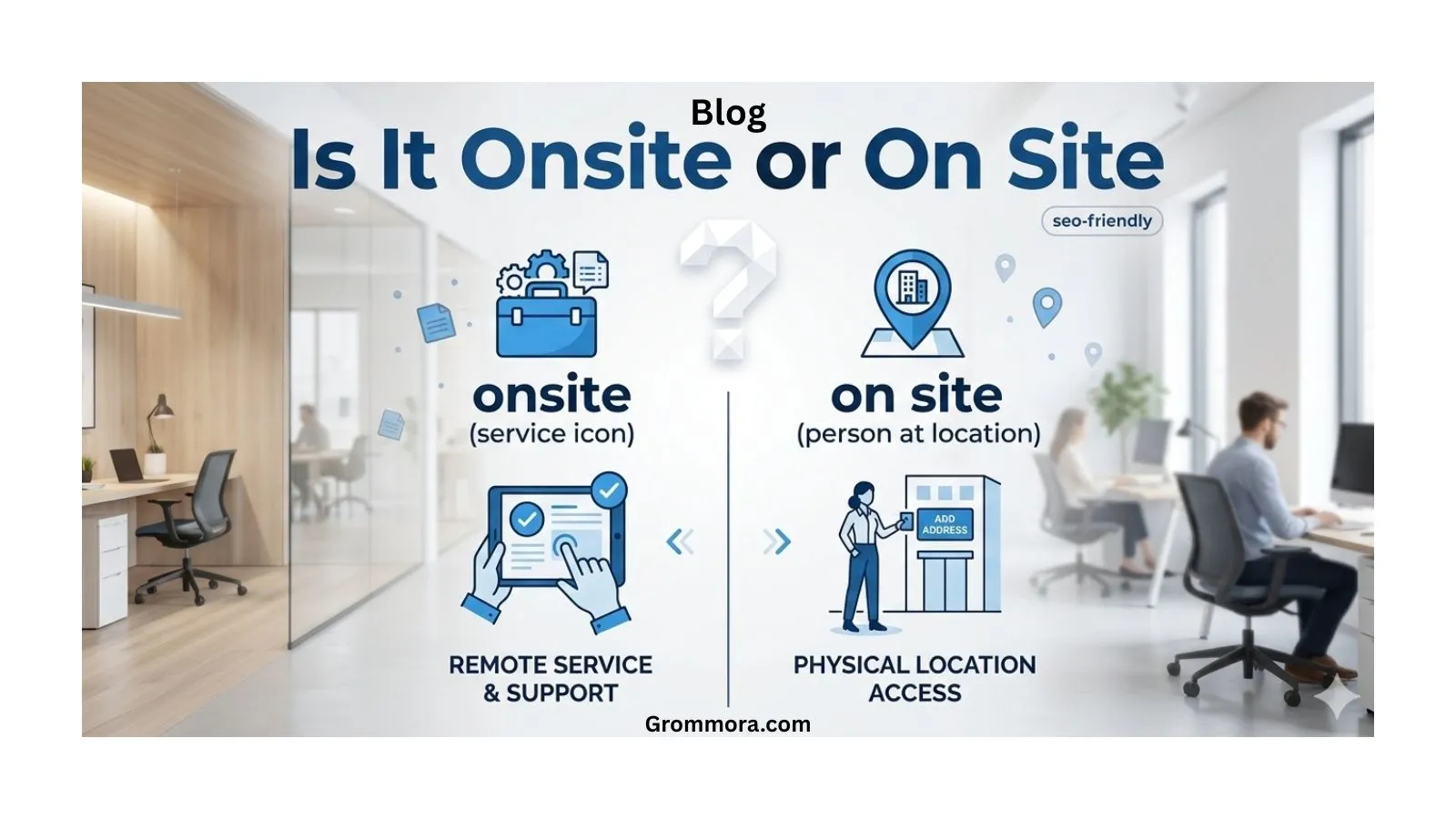
Do you ever wonder whether it’s “onsite” or “on site”? Many people get confused about this, and it’s more common than you think. The distinction matters for professional writing, emails, news articles, and even job postings.
Some search for this phrase because they want to sound polished in business communications, while others are unsure due to differences between American and British English.
|See also Manuel Or Manual
This guide clears the confusion. By the end, you’ll know exactly when to use onsite as one word and on site as two words. You’ll also see examples in daily life, a comparison between British and American usage, common mistakes to avoid, and even Google trends showing how people search for this term worldwide.
Whether you’re drafting a formal report, writing an email, or posting on social media, this article helps you use the right form every time.
Is It Onsite or On Site? – Quick Answer
Quick Answer:
- Onsite (one word) → adjective describing something that happens at a specific location.
- Example: “The company provides onsite technical support.”
- On site (two words) → adverbial phrase meaning “at the location.”
- Example: “The engineers will be on site tomorrow.”
Tip: If it describes a thing or service, use onsite. If it describes where an action happens, use on site.
The Origin of Onsite vs On Site
The difference comes from English grammar and historical usage:
- “On site” appeared first in the 19th century as a simple prepositional phrase. Writers used it literally to mean “at the site.”
- “Onsite” emerged in the mid-20th century as business and tech terms grew. It became common in American English for adjectives describing services at a location.
Over time, onsite became acceptable as a single word in professional contexts, especially in technology, HR, and construction industries. However, older style guides still prefer on site in formal writing.
British English vs American English Spelling
The choice between onsite and on site often depends on your audience:
| Aspect | American English | British English |
|---|---|---|
| Adjective | onsite technical support | on-site technical support |
| Adverb | on site for installation | on site for installation |
| Hyphen Usage | Less common | Often uses hyphen for adjectives |
| Example | “The team offers onsite training.” | “The team offers on-site training.” |
Note: Americans increasingly prefer the single word onsite, while British English often keeps the hyphen or two words.
Which Spelling Should You Use?
- US Audience: Use onsite for adjectives, on site for locations.
- UK/Commonwealth Audience: Use on-site as an adjective and on site as a location phrase.
- Global Audience: Choose the form that matches your style guide or is most common in your industry.
Rule of thumb: Adjective = onsite / on-site, Location = on site.
Common Mistakes with Onsite vs On Site
Many writers confuse the two forms. Here are frequent errors:
| Incorrect | Correct | Explanation |
|---|---|---|
| “We provide support on site.” | “We provide onsite support.” | Adjective form needed |
| “The engineers will arrive onsite tomorrow.” | “The engineers will arrive on site tomorrow.” | Adverb describing location |
| “Please check our on-site policies on site.” | “Please check our on-site policies on site.” | Correctly separates adjective from location |
Onsite vs On Site in Everyday Examples
Emails:
- “We will offer onsite training next week.”
- “The IT team will be on site at 10 AM.”
News Headlines:
- “On-site inspections reveal safety issues.”
- “Workers are on site following the accident.”
Social Media Posts:
- “Our team provides onsite setup for all events.”
- “Join us on site for the live demo.”
Formal Writing:
- “On-site consultation is available by appointment.”
- “Surveyors will be on site during the project.”
Onsite vs On Site – Google Trends & Usage Data
- Global searches: “onsite” is trending more in the US, while “on site” has stable usage in the UK and Australia.
- Professional context: Both forms are commonly used in HR, construction, IT services, and project management.
- Insight: Search data shows confusion often comes from the interchangeable nature of the words in casual writing.
Keyword Variations Comparison Table
| Variation | Part of Speech | Usage Example |
|---|---|---|
| onsite | adjective | “We provide onsite training.” |
| on-site | adjective (British) | “We provide on-site training.” |
| on site | adverb | “The team will be on site at 9 AM.” |
FAQs About Onsite vs On Site
What is correct, on site or onsite?
- Onsite (one word) is an adjective; on site (two words) refers to a location.
Is “on site ever” two words?
- Yes, “on site” is always two words when describing location.
What is meant by onsite?
- Onsite means something happens or is provided at a specific location.
When to hyphen on site?
- Use on-site (hyphen) in British English when it’s an adjective before a noun.
How to use onsite in a sentence?
- Example: “The company offers onsite training for employees.”
Is it on site meeting or onsite meeting?
- Onsite meeting (one word, US English) or on-site meeting (hyphen, UK English) is correct; not “on site meeting.”
Conclusion
Understanding onsite vs on site is simpler than it seems. Remember the key rule: adjective = onsite/on-site, location = on site. American English favors onsite, while British English often hyphenates.
Moreover, using the right form improves clarity in emails, articles, and reports, and demonstrates professionalism. Additionally, by carefully checking your audience and context, you can avoid mistakes, sound polished, and communicate more effectively.
Whether writing for work, school, or social media, following this guide ensures you always choose the correct form. Keep your usage consistent, and the confusion will disappear.