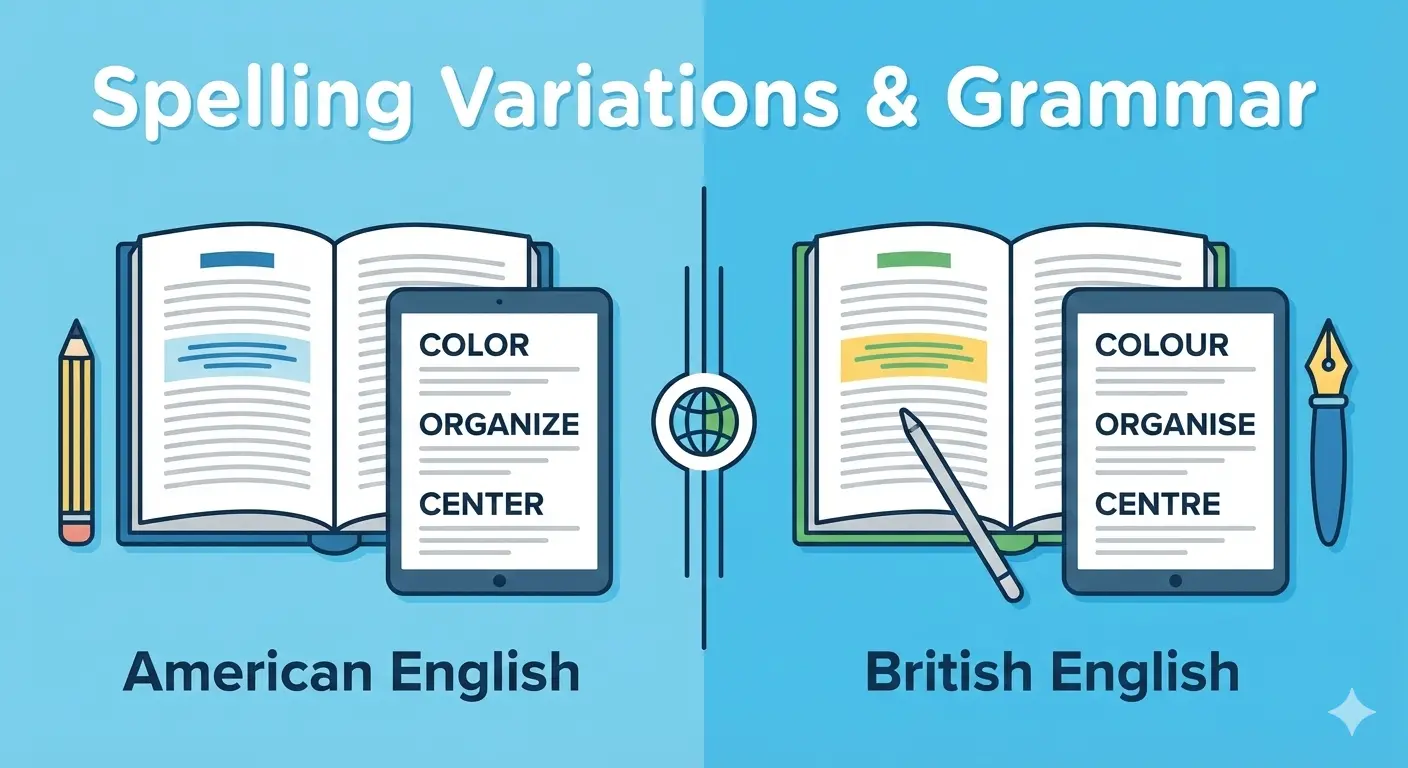
Do you write color or colour? Is it organize or organise? Many people search for Spelling Variations & Grammar because English can feel confusing. Words look different in the US and the UK. Some grammar rules also change by region. This often creates doubt, and as a result, it can negatively affect school work, emails, blogs, and even business writing.
People want quick answers, and consequently, they want to know which spelling is correct. They also want to avoid mistakes.This guide addresses this issue comprehensively. To start with, it explains the problem step by step. First, you’ll discover the reasons behind spelling differences. Then, the disparities between the United States and Britain will become clear. Finally, you’ll learn practical tips for choosing the correct spelling and grammar for your audience. Finally, you’ll receive basic grammar guidance to write confidently.Additionally, you will learn which spelling is appropriate for your target audience.
If you are a student, writer, blogger, or business owner, this guide will help you write with confidence.
Spelling Variations & Grammar & Grammar Chart
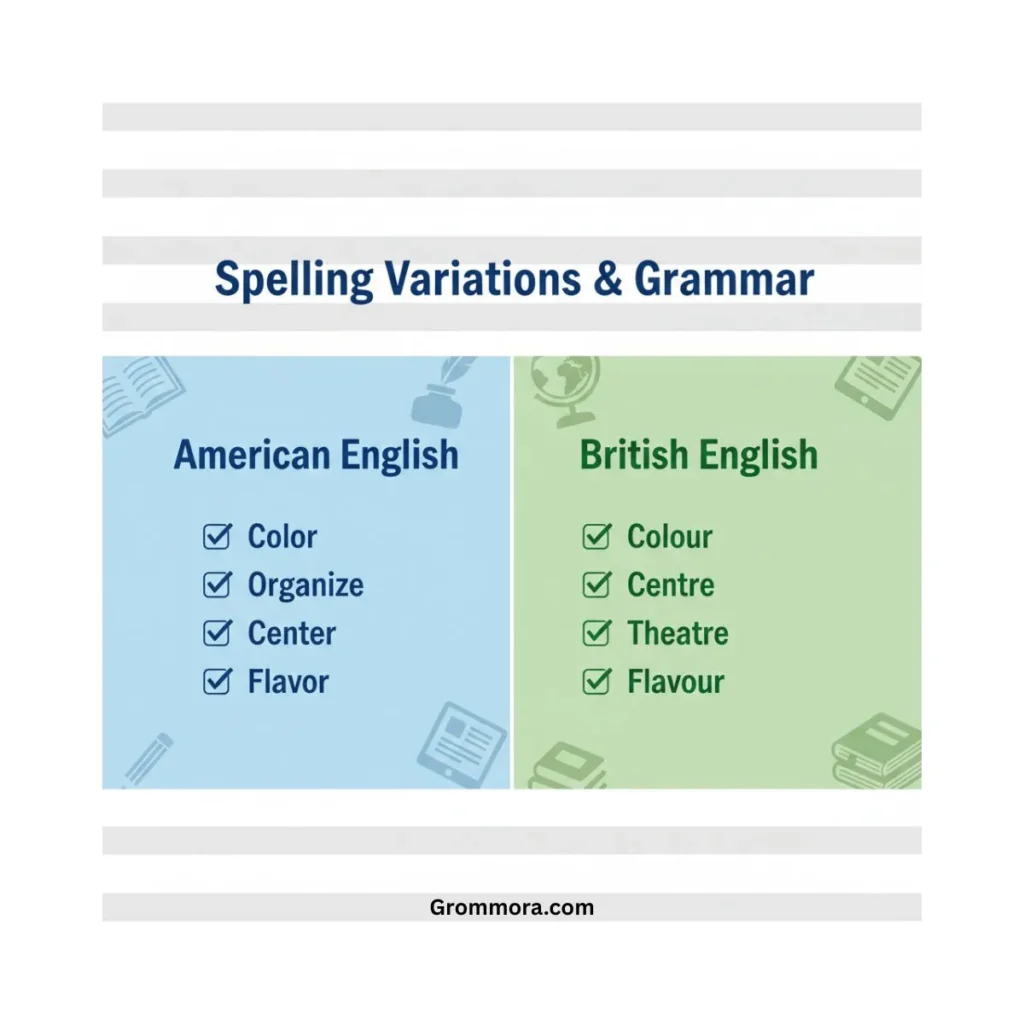
Understanding spelling variations and grammar can be tricky, but a chart makes it simple. First, it allows you to quickly see the differences between American and British English. For example, words like color versus colour or organize versus organise are easy to compare at a glance. Additionally, grammar nuances, such as singular versus plural agreement in collective nouns, are clearer when presented in a table format. Moreover, charts help prevent common mistakes by showing patterns, like when to double letters in British English (travelling vs. traveling). Finally, using a chart ensures consistency in your writing, whether for emails, articles, or academic papers. By referring to a clear chart, you can quickly compare styles; consequently, you save time and, as a result, write confidently across different English styles.
Spelling Variations & Grammar – Quick Answer
Spelling Variations & Grammar refer to differences in how words are written and used in English across regions.
The most common differences are between:
- American English (US)
- British English (UK)
- Commonwealth English (Canada, Australia, etc.)
Quick Examples
- Color (US) → Colour (UK)
- Organize (US) → Organise (UK)
- Center (US) → Centre (UK)
- Traveling (US) → Travelling (UK)
Grammar can also vary slightly:
- US: The team is winning.
- UK: The team are winning.
Both are correct. The choice depends on location and audience.
The Origin of Spelling Spelling Variations & Grammar
English has many roots. It comes from:
- Old English
- Latin
- French
- German
In the 1800s, American dictionaries changed some spellings to make them simpler. For example:
- Colour became Color
- Honour became Honor
British English kept older forms. That is why we see spelling variations today.
Grammar differences grew over time. Each region developed its own style and rules. Media, education, and culture helped shape these changes.
British English vs American English Spelling
Here are the most common spelling patterns:
1. -our vs -or
| American English | British English |
|---|---|
| Color | Colour |
| Honor | Honour |
| Labor | Labour |
2. -ize vs -ise
| American English | British English |
|---|---|
| Organize | Organise |
| Realize | Realise |
| Recognize | Recognise |
3. -er vs -re
| American English | British English |
|---|---|
| Center | Centre |
| Theater | Theatre |
| Meter | Metre |
4. Double Letters
| American English | British English |
|---|---|
| Traveling | Travelling |
| Canceled | Cancelled |
| Labeled | Labelled |
These are spelling differences. The meaning stays the same.
Which Spelling Should You Use?
The answer depends on your audience.
If You Write for the United States:
Use American English spelling and grammar.
If You Write for the UK or Commonwealth:
Use British English spelling.
If You Write for a Global Audience:
Pick one style and stay consistent. Do not mix both styles in the same document.
For business writing:
- Follow your company’s style guide.
- Stay consistent across websites and emails.
Consistency builds trust.
Common Mistakes with Spelling Variations & Grammar
Here are frequent errors:
1. Mixing Styles
Wrong: The organization supports labour rights.
Correct (US): The organization supports labor rights.
Correct (UK): The organisation supports labour rights.
2. Wrong Verb Agreement
US: The team is ready.
UK: The team are ready.
3. Forgetting Double Letters
UK: Travelling (double L)
US: Traveling (one L)
4. Confusing Similar Words
- Affect (verb)
- Effect (noun)
Example:
Correct: The change will affect the result.
Correct: The effect was positive.
Spelling Variations & Grammar in Everyday Examples
Email Example
US:
We will organize the event at the center tomorrow.
UK:
We will organise the event at the centre tomorrow.
News Writing
US:
The government announced a new labor policy.
UK:
The government announced a new labour policy.
On Social Media
US:
I’m traveling to New York!
UK:
I’m travelling to London!
Formal Writing
US Academic Style:
The behavior of the organization was analyzed.
UK Academic Style:
The behaviour of the organisation was analysed.
Spelling Variations & Grammar – Google Trends & Usage Data
Search data shows:
- The United States prefers simplified spellings like color and organize.
- The UK, Australia, and New Zealand prefer colour and organise.
- Canada often mixes both styles but leans toward British spelling.
Online searches for spelling differences are common among:
- Students
- Bloggers
- Content writers
- ESL learners
Global businesses often choose American spelling for a wider reach; on the other hand, local brands typically prefer regional spelling in order to better connect with their audience.
Full Comparison Table of Common Variations
| Category | American English | British English |
|---|---|---|
| Color Words | Color | Colour |
| Honor Words | Honor | Honour |
| Organization | Organization | Organisation |
| Center Words | Center | Centre |
| Traveling | Traveling | Travelling |
| Canceled | Canceled | Cancelled |
| Defense | Defense | Defence |
| License (noun/verb) | License | Licence (noun) |
FAQs
Why did America remove the U?
Noah Webster simplified spellings in the 1800s to make American English shorter and easier, e.g., colour → color.
What are the 4 types of spelling?
Phonetic, visual, morphemic, and conventional spelling.
What are the 12 basic rules of grammar?
Include rules for: sentence structure, subject-verb agreement, punctuation, capitalization, verb tense, pronouns, modifiers, prepositions, conjunctions, articles, clauses, and word order.
What is the 211 rule in spelling?
It’s a mnemonic: double a consonant before adding -ing or -ed if 2-1-1 pattern appears (e.g., run → running).
What is the most mispronounced word in America?
Nuclear is often mispronounced as nucular.
Why do Americans spell canceled with one L?
US spelling drops the second L in past tense for simplicity, while UK keeps double L (cancelled).
Which is correct, Sally and Me or Sally and I?
Use Sally and I as a subject (Sally and I went), Sally and me as an object (He saw Sally and me).
What are common grammar mistakes to avoid?
Mixing tenses, subject-verb disagreement, wrong pronouns, comma splices, and sentence fragments.
What are the 7 types of English grammar?
Nouns, pronouns, verbs, adjectives, adverbs, prepositions, conjunctions.
What are 20 tricky words in English?
Examples: separate, definitely, accommodate, occurrence, its/it’s, their/there/they’re, weird, rhythm, receipt, until…
What is the C rule in spelling?
‘C’ is soft before e, i, y (cent, city, cycle) and hard before a, o, u (cat, cot, cup).
What are the 44 phonetic sounds in order?
English has 24 consonant and 20 vowel sounds; a full order is: /p/, /b/, /t/, /d/, /k/, /g/, /f/, /v/, /θ/, /ð/, /s/, /z/, /ʃ/, /ʒ/, /h/, /m/, /n/, /ŋ/, /l/, /r/, /j/, /w/, plus 20 vowel sounds like /iː/, /ɪ/, /e/, /æ/, /ɑː/, /ɒ/, /ɔː/, /ʊ/, /uː/, etc.
Conclusion
Understanding Spelling Variations & Grammar helps you write clearly and professionally. English has different forms because of history and regional development. In contrast, American English uses simpler spellings like color and organize, whereas British English keeps traditional forms like colour and organise. Grammar differences are small but important.
The key rule is simple: know your audience. If you write for the US, use American spelling. If you write for the UK or Commonwealth countries, use British spelling. Therefore, for global content, it is important to choose one style and stay consistent; otherwise, mixing styles can appear unprofessional.
In fact, small spelling details can affect trust, clarity, and even search rankings.. When you understand these differences, you gain confidence. You also improve your writing quality.
Clear spelling and correct grammar always make a strong impression.