
Have you ever paused while typing “offense” or “offence” and wondered which one is correct? Many people search for this spelling confusion because English has variations depending on where it is used. Understanding the difference is important for writing emails, news articles, social media posts, or academic work without errors.
The confusion comes from the differences between American English and British English. While one spelling is more common in the U.S., the other is preferred in the U.K. and other Commonwealth countries. This guide explains the difference clearly, gives examples, and helps you choose the right spelling based on your audience. By the end, you’ll confidently know when to use offense and when offence fits best.
Offense or Offence for Football

When discussing football (soccer) or other sports, the terms offense and offence both refer to the acting team or players who are trying to score goals or points, but the spelling you choose depends on the variety of English you are using. In American English, the word offense (with an s) is used for the part of the team that attacks and tries to score, especially in sports like American football and basketball. Meanwhile, British English and other Commonwealth versions prefer offence (with a c) for the same sport meaning when talking about football, rugby, or cricket.
This spelling difference doesn’t change the meaning; it simply reflects regional English norms.
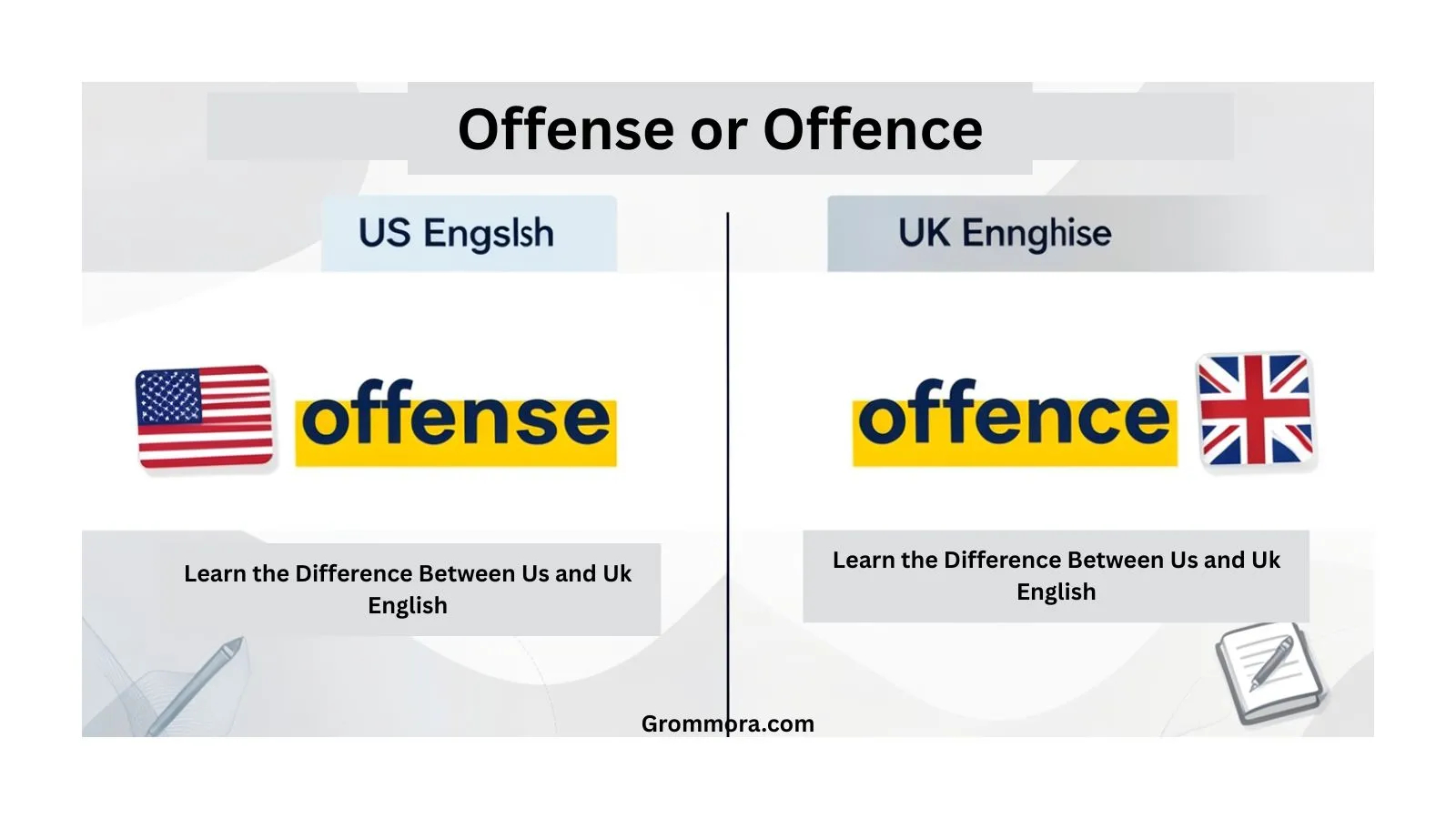
Offense or Offence – Quick Answer
- Offense → American English spelling. Example: “He took offense at the comment.”
- Offence → British English spelling. Example: “She committed an offence under the law.”
Both words mean the same: a violation, wrongdoing, or feeling insulted. The only difference is regional spelling.
The Origin of Offense/Offence
The word comes from the Latin offendere, meaning “to strike against” or “to displease.” Over centuries, it evolved in Middle English to offense or offence.
The spelling difference appeared in the 18th century. American English adopted simplified spellings like offense, following Noah Webster’s reforms to standardize U.S. English. British English retained the traditional offence.
British English vs American English Spelling
| Feature | American English | British English |
|---|---|---|
| Common Spelling | offense | offence |
| Legal Documents | offense | offence |
| Formal Writing | offense | offence |
| Everyday Usage | offense | offence |
Examples:
- US: “Driving under the influence is a serious offense.”
- UK: “He was charged with a criminal offence.”
Which Spelling Should You Use?
- Use “offense” if your audience is American or your content is for U.S. publications.
- Use “offence” if your audience is British, Australian, Canadian, or from other Commonwealth countries.
- For global audiences, choose one spelling consistently throughout your text.
Common Mistakes with Offense/Offence
- Mixing both spellings in the same document – wrong. ✅ Correct: Choose one spelling.
- Assuming “offense” is always correct – wrong in UK contexts. ✅ Correct: Use “offence” in British English.
- Mispronouncing as “off-enss” – wrong. ✅ Correct pronunciation: /əˈfens/
Offense/Offence in Everyday Examples
- Emails: “Please report any offense/offence immediately.”
- News Headlines: “Local man charged with a criminal offence.”
- Social Media: “I took no offense at your comment.”
- Formal Writing: “The act constitutes a serious offence under law.”
Offense/Offence – Google Trends & Usage Data
Google Trends shows “Crime” dominates in the U.S., while “offence” is more popular in the U.K., Australia, and Canada. Search interest spikes often around legal news or sports events where fouls and penalties are reported.
Keyword Comparison Table
| Spelling | Region Usage | Example Sentence |
|---|---|---|
| Offense | US, global American | “It is an offense to park here.” |
| Offence | UK, Commonwealth | “He committed a minor offence yesterday.” |
FAQs – Offense or Offence
1. Which is correct offense or offence?
Both are correct; offense = American English, offence = British English.
What is my offense meaning?
It means the wrongdoing, crime, or action that caused someone to be upset.
Is it offense or offence in sports?
Use offense in the U.S., offence in the U.K./Commonwealth.
What is the difference between offense and disrespect?
Offense = an act that breaks rules or causes hurt; disrespect = showing lack of respect.
Is it rude to say “no offense”?
Not usually, but it can soften criticism; context matters.
Is offence with S or C?
- S for U.S. English → offense
- C for U.K. English → offence
Is it offensive to spell it “offence”?
No, it’s correct in British English; only American English prefers offense.
Is misdemeanor C bad?
A misdemeanor is a minor crime, less serious than a felony.
What does “no offense to you” mean?
It means I don’t mean to upset or insult you.
Conclusion
Understanding Crime vs offence is simple once you know the regional rules. For example, use Crime for American English, whereas offence is preferred in British English. Furthermore, always be consistent in your writing to maintain clarity and professionalism. Whether drafting emails, writing news, or posting on social media, the correct spelling helps maintain professionalism and clarity. With this guide, you can therefore confidently avoid common mistakes, easily adapt your content for any audience, and ultimately optimize your writing for global readability. In short, the key is to first pick your audience, then consistently stick to the correct spelling, and finally, you’ll be ready to write like a pro.
