

You’ve probably typed “on site or onsite” into Google because you saw both versions used—and now you’re confused. You’re not alone. This is a very common language question, especially for writers, students, SEO experts, and professionals. Both spellings look right. Both appear in articles, emails, and job posts. But are they the same? And which one should you use?
People search for this keyword because English keeps changing. Words that were once written as two words often become one word over time. Think of web site becoming website. The same thing is happening here. The confusion usually shows up when writing formal content, contracts, blogs, or resumes. Using the “wrong” version can make your writing look unpolished or inconsistent.
This article clears that confusion fast. You’ll get a quick answer, real examples, spelling history, British vs American usage, common mistakes, and expert advice. By the end, you’ll know exactly when to use on site and when onsite is the better choice.
On Site or Onsite Examples
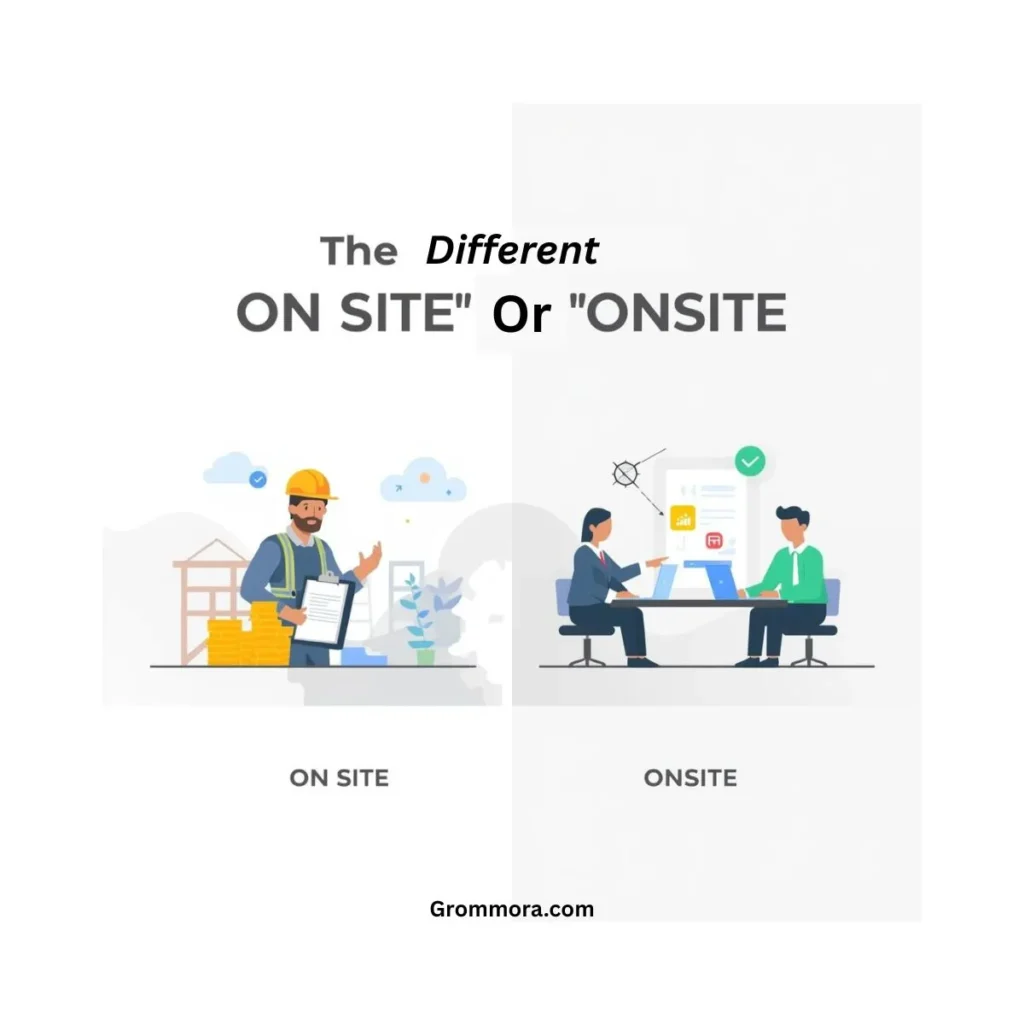
Understanding on site and onsite becomes easier when you see them used in real sentences. Use on site when you are talking about a physical location or someone being present at a place. For example, “The safety inspector is on site to check the equipment,” or “Doctors were on site during the event.” Use onsite when the word describes a service, activity, or feature that comes with something. For instance, “The company offers onsite training for new employees,” or “Guests can enjoy onsite parking at the hotel.” In casual writing like emails or social media, both forms are common, but the rule stays the same. Location needs on site, while services and features use onsite. This simple distinction helps your writing sound clear and professional every time.
On Site or Onsite – Quick Answer
Short answer:
Both on site and onsite are correct—but they are used differently.
- On site (two words) is more traditional and formal.
Example: The engineer will be on site tomorrow. - Onsite (one word) is modern and common in business and tech writing.
Example: We offer onsite training.
Rule of thumb:
If you want safe, formal writing → use on site
If you want modern, professional writing → use onsite
The Origin of On Site / Onsite
The phrase comes from the word “site”, meaning a location or place.
Originally, English preferred open forms (two words). So on site came first.
Over time, English merges frequent word pairs:
- web site → website
- data base → database
- on line → online
The same pattern applies here. As workplaces and technology evolved, onsite became popular, especially in American English and corporate writing.
So the spelling difference exists because of language evolution, not grammar mistakes.
British English vs American English Spelling
British and American English often handle compound words differently.
| Aspect | British English | American English |
|---|---|---|
| Preferred form | on site | onsite |
| Formal writing | on site | onsite |
| Business usage | on site | onsite |
| Modern trend | slowly changing | already merged |
Example:
- UK: Staff must remain on site during work hours.
- US: We provide onsite customer support.
Which Spelling Should You Use?
Choose based on your audience:
- US audience: Use onsite
- UK / Commonwealth audience: Use on site
- Global or SEO content: Either is fine—just be consistent
- Legal or academic writing: Prefer on site
Consistency matters more than the spelling itself.
Common Mistakes with On Site / Onsite
Here are mistakes people often make:
Wrong: Mixing both forms in one document
✔ Pick one and stick to it
❌ Writing onsite in very formal legal text
Write: Use on site for formal tone
Wrong: Assuming one version is “wrong”
Write: Both are correct English
❌ Using on-site randomly
✔ Hyphen is optional but less common today
On Site / Onsite in Everyday Examples
Emails
- Please remain on site until the inspection ends.
News
- Police officers were on site within minutes.
Social Media
- We’re offering onsite repairs today!
Formal Writing
- An on site assessment will be conducted.
Business & HR
- This role requires onsite presence.
On Site or Onsite – Google Trends & Usage Data
Search data shows:
- Onsite is more popular in the United States
- On site remains strong in the UK, Australia, and India
- Tech, HR, and job listings prefer onsite
- News and academic writing prefer on site
Google treats both spellings as valid, so SEO impact is minimal—as long as usage matches intent.
Comparison Table: On Site vs Onsite
| Feature | On Site | Onsite |
|---|---|---|
| Word form | Two words | One word |
| Formal tone | Yes | Medium |
| Modern usage | Traditional | Modern |
| US preference | Less | High |
| UK preference | High | Less |
| SEO impact | Neutral | Neutral |
FAQs: On Site or Onsite
1. Is it on site or onsite?
Both are correct. On site is traditional and formal; onsite is modern and common in business English.
2.Is it on site meeting or onsite meeting?
Both work, but onsite meeting is more common in modern and professional usage.
3.Is there a hyphen between on site?
No hyphen is needed. On-site is acceptable but less common today.
4.What does being onsite mean?
Being onsite means physically present at a specific location, not remote.
5.Is it customer on-site or onsite?
Both are correct, but customer onsite is preferred in business and tech writing.
6.What does “onsite” mean in a job?
Onsite means the job requires working at the office or location, not from home.
7.What is onsite hiring?
Onsite hiring means interviews and selection happen at a physical location.
8.What does “pay onsite” mean?
Pay onsite means payment is made at the location, in person.
9.What is meant by work on site?
Work on site means doing your job at the actual workplace or project location.
Conclusion
The debate around on site or onsite is not about right or wrong—it’s about context. Both spellings are correct and widely used in English today. The key difference lies in tone, audience, and region. On site is the older, more formal version and fits well in academic, legal, and British English writing. Onsite is modern, concise, and preferred in American English, business, HR, and tech content.
For SEO and professional writing, consistency matters more than the spelling choice itself. Pick the version that best matches your audience and purpose, then use it throughout your content. If you’re writing for a global audience, either form works as long as it feels natural and clear.
Understanding this small detail helps your writing look polished, confident, and professional. Now you can use on site or onsite without second-guessing.