Have you ever paused while writing and wondered: is it dialog or dialogue? You’re not alone. As a result, this is one of the most searched English spelling questions online. Writers, students, bloggers, and even professionals often get stuck on this small but confusing choice. The reason is simple: both spellings are correct, but they are used differently depending on context and region.
People search for “dialog or dialogue” because they want a quick, clear answer without grammar jargon. As a result, they want to know which spelling looks professional, whether it fits American or British English, and which one Google prefers for SEO. Because of this, the confusion shows up everywhere—from novels and emails to academic papers, subtitles, and even software interfaces.
This article solves that confusion completely. You’ll get a fast answer first, then a deeper explanation with examples, tables, and practical advice. By the end, you’ll know exactly when to use dialog, when to use dialogue, and why—without overthinking it.
Dialog or Dialogue in Everyday Examples
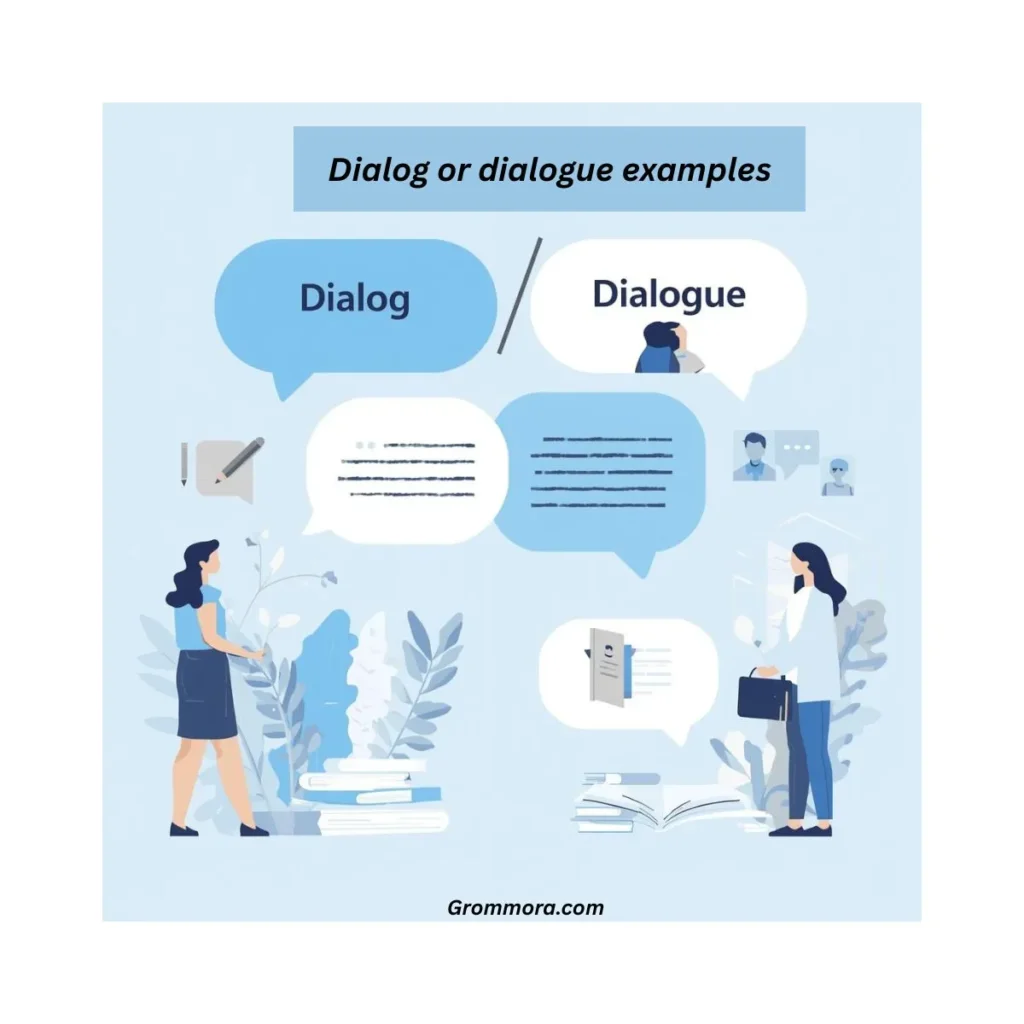
Understanding how to use dialog or dialogue in real life helps you write clearly and professionally. In everyday communication, dialogue is often used in literature, emails, news articles, and social media. For instance, in novels, you might write: “The dialogue between the characters revealed their true feelings.” In professional emails: “Let’s maintain an open dialogue to improve teamwork.” In news articles: “Leaders held dialogue to resolve the conflict.” On social media: “We need more honest dialogue online.”
Meanwhile, dialog is commonly used in software or technical contexts. For example, when using a computer, you might see: “Click the OK button in the dialog box to proceed.” Knowing when to use each ensures clarity and prevents mistakes.
Dialog or Dialogue – Quick Answer
Both “dialog” and “dialogue” mean a conversation between two or more people.
- Dialogue is the standard spelling in British English and most of the world.
- Dialog is the American English variant, mainly used in technical or software contexts.
Examples:
- The novel has strong dialogue. (British / global)
- Open the dialog box to continue. (American / technical)
The Origin of Dialog or Dialogue
The word comes from the Greek word “dialogos”, meaning “conversation” or “discussion.”
It passed into Latin, then Old French, and finally into English.
Originally, dialogue was the only accepted spelling. Over time, American English began simplifying spellings to make words shorter and more phonetic. This is how dialog appeared.
That’s why both spellings exist today:
- Dialogue kept its traditional form.
- Dialog evolved through American spelling reform.
British English vs American English Spelling
Here’s how the two spellings are used today:
| Aspect | Dialogue | Dialog |
|---|---|---|
| British English | ✅ Correct | ❌ Rare |
| American English | ✅ Correct | ✅ Correct |
| Literature & fiction | ✅ Preferred | ❌ Uncommon |
| Software & UI | ❌ Rare | ✅ Common |
| Academic writing | ✅ Preferred | ❌ Avoided |
Example:
- UK: The dialogue in the play was powerful.
- US tech: Click OK to close the dialog.
Which Spelling Should You Use?
Choose based on your audience:
- US audience:
Use dialog for software and tech. Use dialogue for writing and stories. - UK & Commonwealth (UK, Canada, Australia):
Always use dialogue. - Global or SEO-focused content:
Dialogue is the safest and most widely accepted choice.
Pro tip: If unsure, choose dialogue. It’s rarely wrong.
Common Mistakes with Dialog or Dialogue
Here are frequent errors people make:
Wrong: The dialog in the novel was boring.
✅ The dialogue in the novel was boring.
❌ Click the dialogue box to continue.
✅ Click the dialog box to continue.
❌ Mixing both spellings in one article
✅ Stay consistent with one spelling style
Dialog or Dialogue in Everyday Examples
Emails:
- Let’s keep an open dialogue about the project.
News:
- Leaders began dialogue to reduce tensions.
Social Media:
- We need more honest dialogue online.
Formal Writing:
- The study analyzes political dialogue.
Software UI:
- A settings dialog appeared on screen.
Dialog or Dialogue – Google Trends & Usage Data
Search data shows:
- Dialogue is more popular in the UK, Europe, India, and Australia.
- Dialog spikes in the United States, mainly in tech searches.
- Globally, dialogue is searched more often overall.
This means content writers and bloggers usually benefit from using dialogue, while developers prefer dialog.
Dialog vs Dialogue – Side-by-Side Comparison
| Feature | Dialog | Dialogue |
|---|---|---|
| Meaning | Conversation | Conversation |
| English type | American | British / Global |
| Common use | Software, UI | Writing, speech |
| SEO safety | Medium | High |
| Formal writing | ❌ | ✅ |
FAQs: Dialog or Dialogue
1. What is correct, dialog or dialogue?
Both are correct; dialogue is standard globally, while dialog is common in American tech contexts.
2.Is dialog British or American?
Dialog is American, mostly used in software; dialogue is British and global.
3.What is the meaning of dialog?
It means a conversation between two or more people.
4.Is it dialog or dialogue Canada?
Dialogue is preferred in Canada, following British English conventions.
5.When did dialog become an accepted spelling?
It became accepted in American English during the 20th century for simplicity and tech use.
6.How do you know if a word is British or American?
Check the spelling, dictionary, or style guide, or see where it’s commonly used.
7.How do Brits say hurry up?
Brits often say: “Come on” or “Get a move on.”
8.Why do British people say “er” instead of “a”?
It’s due to vowel pronunciation differences in British English accents.
9.How do British say water?
In British English, it’s usually pronounced like “waw-tuh” (rhymes with “bother”).
Conclusion
However, the confusion between dialog or dialogue comes from regional spelling differences, not meaning. Both words describe a conversation, but their usage depends on where and how you are writing. If your audience is global, academic, or literary, dialogue is the best and safest choice. As a result, it looks polished, professional, and widely accepted.
On the other hand, dialog has a clear place in American English, especially in software, programming, and user interfaces. For example, seeing “dialog box” in an app is completely correct and expected. However, the key is consistency—so don’t mix both spellings in the same document.
When in doubt, ask yourself two questions:
Who is my audience? And what is my context?
Answer those, and the right spelling becomes obvious.